If you live with Sjögren’s disease, you already know the frustrating part: for decades, there was no medicine that actually treated the disease itself. Doctors could help with the dry eyes and dry mouth, but nothing slowed down what was happening underneath.
That is finally changing.
In the last two years, several new drugs have shown real promise in clinical trials — and one of them just became the first to succeed in a large, final-stage study.
As a rheumatologist, I want to walk you through what these drugs are, how they work, and what the research honestly shows.
No hype. Just a clear picture so you can have a smarter conversation with your own doctor.
What is Sjögren’s disease?
Sjögren’s disease (also spelled Sjogren’s, and sometimes called Sjögren’s syndrome) is an autoimmune disease. That means your immune system, which is supposed to fight germs, mistakenly attacks your own body instead. In Sjögren’s, the immune system mainly targets the glands that make moisture — your tear glands and saliva glands. That is why the two most common symptoms are dry eyes and dry mouth.
But Sjögren’s is not “just dryness.” It is a whole-body disease that can also cause:
- Deep fatigue that does not improve with rest
- Joint pain and stiffness
- Brain fog and trouble concentrating
- Nerve pain or tingling
- Problems with the kidneys, lungs, or other organs in more serious cases
- A higher long-term risk of a type of cancer called lymphoma
Sjögren’s affects far more women than men — roughly 9 out of 10 patients are women. Many people go years without a clear diagnosis, often being told their symptoms are “just stress” or aging.
Why has Sjögren’s been so hard to treat?
Here is the honest answer: until very recently, there were zero approved medicines that change the course of Sjögren’s disease.
Everything doctors used was either borrowed from other autoimmune diseases or aimed only at easing symptoms. Part of the problem was the disease itself. Sjögren’s looks different in different people.
One woman might have severe organ involvement but feel okay day to day, while another might feel terrible but have “normal” test results. That made it very hard to design trials that could prove a drug truly worked.
Researchers have since gotten much better at measuring the disease and choosing the right patients for studies. That progress is a big reason why so many trials are finally succeeding now.
What does Sjögren’s treatment look like right now?
Today’s standard care still focuses on managing symptoms and protecting the body. It usually includes a mix of the following:
- Medicines that boost moisture. Pills like pilocarpine and cevimeline help the glands make more saliva.
- Prescription eye drops. Cyclosporine eye drops help calm inflammation in dry eyes.
- Hydroxychloroquine. Often used for joint pain and fatigue, though the research behind it is weaker than we would like.
- Stronger immune medicines for serious cases. When Sjögren’s attacks organs, doctors may use steroids, methotrexate, mycophenolate, azathioprine, or cyclophosphamide.
- Rituximab. This B-cell medicine is sometimes used “off-label” for certain severe complications, but trial results have been mixed.
This care can genuinely help. But notice what is missing: a treatment that targets the root cause for most patients. That is exactly the gap the new drugs are trying to fill.
How do you treat the most common Sjögren’s symptoms?
Most people want practical answers for the symptoms they feel every day. Here is the short version for each.
Dry eyes. Start with over-the-counter artificial tears (the preservative-free kind if you use them often). If that isn’t enough, a doctor can prescribe cyclosporine or lifitegrast eye drops to calm the inflammation. For stubborn cases, an eye doctor can place tiny “punctal plugs” that keep your natural tears from draining away.
Dry mouth. Sip water through the day, chew sugar-free gum, and use saliva sprays or lozenges. Prescription pills like pilocarpine or cevimeline can tell your glands to make more saliva. Because dry mouth raises your risk of cavities, regular dental care and fluoride matter a lot.
Fatigue. This is one of the hardest symptoms and there’s no single fix. Steady sleep, gentle regular movement, treating low iron or thyroid problems, and controlling the disease itself all help. Hydroxychloroquine is sometimes tried, though the evidence is mixed.
Joint pain. Over-the-counter anti-inflammatory medicines (like ibuprofen) help mild aches. For ongoing joint pain, hydroxychloroquine is the usual next step, and stronger immune medicines are added if needed.
Vaginal and skin dryness. Vaginal moisturizers, hyaluronic acid products, and (after menopause) vaginal estrogen can help. For skin, fragrance-free moisturizers and gentle cleansers make a difference.
The key point: these treatments ease symptoms but don’t stop the disease. That’s why the new drugs below matter so much.
The one simple idea behind all the new drugs
Before the drug names, here is the whole concept in one picture. Think of your immune system as a security team. In Sjögren’s, a few of the guards get confused and start attacking your own moisture glands by mistake.
The main troublemakers are immune cells called B cells.
These troublemaker cells do three things:
- They multiply and stick around.
- The body keeps “feeding” them signals that keep them alive.
- They make harmful proteins (called antibodies) that cause damage.
That’s it. Almost every new drug simply interrupts one of those three steps:
- Remove the troublemakers, or
- Cut off their food supply, or
- Clean up the harmful proteins they leave behind.
Once you have that picture, every drug below is just a different way of doing one of those three things. You don’t need to memorize any of it — this is just so the names make sense.
What are the new drugs being studied for Sjögren’s disease?
New drugs are tested in steps. The later the step, the closer a drug is to being approved and available. Here’s where the leaders stand.
Closest to approval
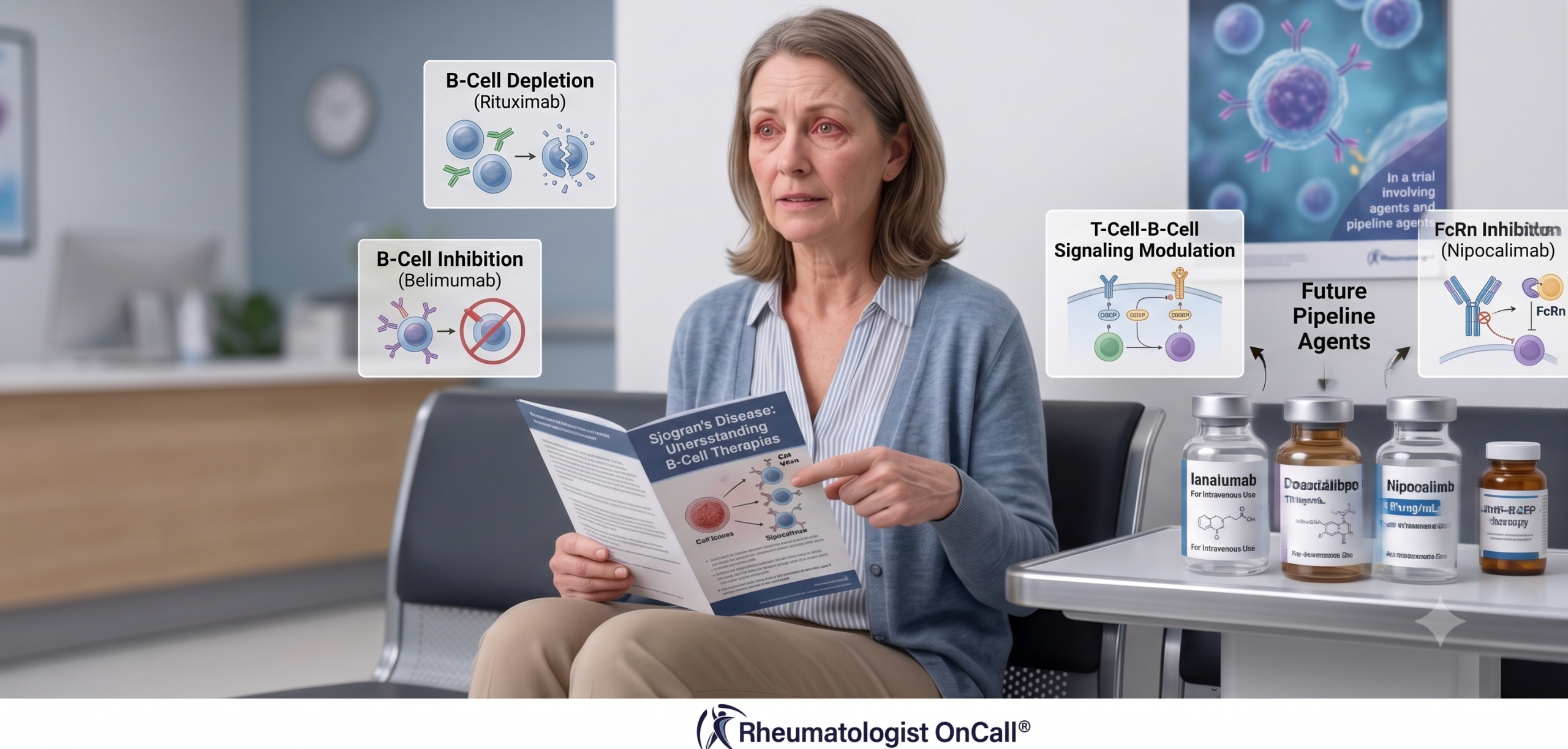
Ianalumab is the big news. In two large trials involving 779 patients, it clearly worked better than placebo. It does two jobs at once: it removes the troublemaker cells and cuts off one of their food signals. It’s the first drug ever to pass the final testing stage for Sjögren’s. The FDA fast-tracked it, and the maker planned to ask for approval in 2026. If that happens, it would be the first true treatment for this disease.
Telitacicept also passed the final stage, in a study of 381 patients. It cuts off two of the troublemakers’ food signals at once. About 7 in 10 patients on the higher dose improved, compared with about 2 in 10 on placebo.
Still being studied (promising mid-stage results)
Iscalimab and dazodalibep work the same basic way: they stop the immune cells from teaming up. (Immune cells need to “shake hands” to rile each other up — these block the handshake.) Both improved disease activity in their trials.
Nipocalimab takes a different path. It doesn’t touch the cells at all. Instead, it removes harmful proteins from the blood. It met its main goal in its trial and was fast-tracked by the FDA.
Remibrutinib is a pill (not an injection) that quiets the troublemaker cells from the inside. Early results look encouraging.
Low-dose IL-2 does the opposite of attacking — it strengthens the body’s own “calm-down” cells. A small study showed improvement.
A simple cheat sheet
| Drug | In one sentence | How far along |
|---|---|---|
| Ianalumab | Removes the troublemaker cells and cuts off a food signal | Closest to approval |
| Telitacicept | Cuts off two of the cells’ food signals | Closest to approval |
| Iscalimab | Stops immune cells from teaming up | Still being studied |
| Dazodalibep | Stops immune cells from teaming up (other side) | Still being studied |
| Nipocalimab | Cleans harmful proteins out of the blood | Still being studied |
| Remibrutinib | A pill that quiets the cells from the inside | Early studies |
| Low-dose IL-2 | Boosts the body’s own “calm-down” cells | Early studies |
The big takeaway: doctors are no longer guessing.
Each of these drugs targets a specific, well-understood part of the problem — and several are working.
A quick reality check
It’s exciting that these drugs are working. But good medicine means being honest.
The trials clearly show that these drugs calm the disease down. What’s still being worked out is how much better people feel day-to-day — things like dryness and fatigue improved less than the doctors’ disease scores did, and the amount of relief varies from person to person.
That’s not a reason to lose hope. Just the opposite. This is the first time we’ve had drugs that change the disease at all. The next step is figuring out which drug best fits which patient.
What about CAR-T and other future approaches?
Beyond the drugs above, scientists are testing even bolder ideas for the toughest cases:
- CAR-T cell therapy — a powerful approach that retrains your own cells to clear out the troublemakers. It’s being studied for the most severe, hard-to-treat cases.
- A handful of other medicines that target different inflammation pathways, some of them pills.
These are still early, but they show how fast this field is moving after decades of little progress. (If you want to go deeper on CAR-T, see our companion article on CAR-T cell therapy for autoimmune disease.)
When will these new Sjögren’s treatments be available?
No disease-modifying drug is FDA-approved for Sjögren’s yet. But ianalumab is the furthest along, with regulatory submissions expected to begin in 2026. Others are following close behind. The next few years are likely to bring the first approved targeted treatments in the history of this disease.
Thinking through your Sjögren’s care? Let’s talk.
If you have Sjögren’s — or you suspect you do and feel like no one is taking your symptoms seriously — you deserve a rheumatologist who understands both the disease and the science driving these new treatments.
At Rheumatologist OnCall, we offer virtual rheumatology visits focused on women’s autoimmune health, with the time and attention to walk through your options, your labs, and what the latest research means for you. You can meet with a board-certified rheumatologist from home, often much faster than the months-long wait for an in-person specialist.
If you would like a clear, personalized look at your Sjögren’s care, we would be glad to help.
Frequently asked questions about Sjögren’s disease treatment
What is the best treatment for Sjögren’s syndrome?
There is no single “best” treatment — it depends on your symptoms and which parts of your body are affected. Most people use a mix of moisture treatments (eye drops, saliva products), medicines for pain or fatigue, and, for more serious disease, medicines that calm the immune system.
Is there a cure for Sjögren’s disease?
No, there is no cure yet. But for the first time, drugs that target the disease itself — not just the symptoms — are succeeding in trials and moving toward approval.
What kind of doctor treats Sjögren’s disease?
A rheumatologist is the specialist who manages Sjögren’s. You may also see an eye doctor for dry eyes and a dentist for dry mouth, but the rheumatologist guides your overall treatment plan.
Can Sjögren’s be treated without strong immune-suppressing drugs?
For mild cases, yes — moisture medicines, eye drops, and lifestyle steps can be enough. More active or organ-involved disease often needs medicines that calm the immune system, and now, potentially, the newer targeted drugs.
Can diet or lifestyle changes help Sjögren’s?
They won’t cure it, but they help. Staying hydrated, not smoking, gentle regular exercise, good dental care, and managing stress and sleep can all ease symptoms and support your overall treatment.
How do you treat dry eyes from Sjögren’s?
Start with preservative-free artificial tears. If that isn’t enough, prescription drops like cyclosporine or lifitegrast reduce inflammation, and an eye doctor can place tiny “punctal plugs” to keep your natural tears from draining away.
How do you treat dry mouth from Sjögren’s?
Sip water often, chew sugar-free gum, and use saliva sprays or lozenges. Prescription pills like pilocarpine and cevimeline help your glands make more saliva. Regular dental care is important because dry mouth raises cavity risk.
What helps with Sjögren’s fatigue?
There’s no single fix, but steady sleep, gentle exercise, and treating other causes like low iron or thyroid problems all help. Controlling the disease itself often improves energy too.
How do you treat Sjögren’s joint pain?
Mild aches often respond to over-the-counter anti-inflammatory medicines. For ongoing pain, hydroxychloroquine is the usual next step, with stronger immune medicines added when needed.
Does hydroxychloroquine help Sjögren’s?
It is commonly prescribed for joint pain and fatigue and many patients feel it helps, though the formal research behind it is weaker than for some other uses. Your rheumatologist can help weigh whether it’s right for you.
Does rituximab work for Sjögren’s?
Rituximab is used off-label for certain severe complications, such as a blood-vessel problem called cryoglobulinemia-related vasculitis. Trial results for everyday symptoms have been mixed, so it is not a routine treatment for most patients.
Is there a new treatment for Sjögren’s disease?
Yes. Several new drugs — including ianalumab, telitacicept, iscalimab, dazodalibep, and nipocalimab — have shown positive trial results. Ianalumab is the first to succeed in final-stage testing and is closest to approval.
What is the first new drug likely to be approved for Sjögren’s?
Ianalumab. It was the first drug to succeed in final-stage trials and received FDA Breakthrough Therapy status, with regulatory submissions expected to begin in 2026.
Are these new Sjögren’s drugs available now?
Not yet. As of 2026, none are FDA-approved for routine use, though some patients may have access through clinical trials. A rheumatologist can tell you whether a trial might be an option.
How are these new treatments different from current ones?
Today’s treatments mostly ease symptoms like dryness. The new drugs target the overactive immune cells and signals that cause the disease, which is why doctors hope they can actually slow it down.
Do these drugs help with dryness and fatigue, or just lab results?
They clearly reduce disease activity measured by doctors. The effect on everyday symptoms like dryness and fatigue has been more modest and varies from person to person — an active area of ongoing research.
Can Sjögren’s go into remission?
Symptoms often come and go, with quieter periods and flares. A true, lasting remission is uncommon, but good treatment can keep the disease well-controlled for long stretches.
What happens if Sjögren’s is left untreated?
Untreated dryness can lead to eye damage and frequent cavities, and ongoing inflammation can affect the joints, nerves, or organs in some people. Regular care helps catch and prevent these problems early.
Does Sjögren’s get worse over time?
It varies. Many people stay stable with mild symptoms for years, while a smaller number develop organ involvement. Regular follow-up helps your doctor spot changes early.
Does Sjögren’s affect life expectancy?
For most people, Sjögren’s does not shorten life. The main long-term concern is a higher risk of a cancer called lymphoma in a minority of patients, which is one reason ongoing monitoring matters.
Does Sjögren’s increase cancer risk?
It carries a higher long-term risk of lymphoma. This is one reason regular follow-up with a rheumatologist matters, even when symptoms feel manageable.
What’s the difference between Sjögren’s disease and Sjögren’s syndrome?
They’re the same condition. “Sjögren’s disease” is the newer preferred name. The word “syndrome” was often used when it appeared alongside another autoimmune disease like lupus or rheumatoid arthritis.
Is Sjögren’s related to lupus or rheumatoid arthritis?
It can be. Sjögren’s may occur on its own (primary) or alongside another autoimmune disease such as lupus or rheumatoid arthritis (secondary). They share some features but are distinct conditions.
Can I see a rheumatologist online for Sjögren’s?
Yes. Virtual rheumatology visits, like those at Rheumatologist OnCall, let you get specialist care from home — useful given the long wait times for in-person appointments.
References
- Bhurani M, Lee AYS, Rischmueller M, Hoi A. Evolving Treatments for Sjögren Disease: Current Approaches and Emerging Targets. Internal Medicine Journal. 2026.
- Grader-Beck T, Mariette X, Finzel S, et al. Ianalumab demonstrates significant reduction in disease activity in patients with Sjögren’s disease: efficacy and safety results from two global phase 3 studies (NEPTUNUS-1 and NEPTUNUS-2) [abstract]. Arthritis Rheumatol. 2025;77(suppl 9). Presented at ACR Convergence 2025.
- Bowman SJ, Fox R, Dörner T, et al. Safety and efficacy of subcutaneous ianalumab (VAY736) in patients with primary Sjögren’s syndrome: a randomised, double-blind, placebo-controlled, phase 2b dose-finding trial. Lancet. 2022;399:161–171.
- Xu D, Zhang S, Qiao L, et al. Efficacy and safety of telitacicept in patients with Sjögren’s disease: results from a multicenter, randomized, double-blind, placebo-controlled, phase 3 clinical study [abstract]. Arthritis Rheumatol. 2025;77(suppl 9). Presented at ACR Convergence 2025.
- Fisher BA, Mariette X, Bombardieri M, et al. Safety and efficacy of subcutaneous iscalimab (CFZ533) in two distinct populations of patients with Sjögren’s disease (TWINSS): week 24 results of a randomised, double-blind, placebo-controlled, phase 2b dose-ranging study. Lancet. 2024;404:540–553.
- St Clair EW, Baer AN, Ng WF, et al. CD40 ligand antagonist dazodalibep in Sjögren’s disease: a randomized, double-blinded, placebo-controlled, phase 2 trial. Nat Med. 2024;30:1583–1592.
- Gottenberg J-E, Sivils K, Campbell K, et al. Efficacy and safety of nipocalimab in patients with moderate-to-severe Sjögren’s disease (DAHLIAS): a randomised, phase 2, placebo-controlled, double-blind trial. Lancet. 2025.
This article is for educational purposes and does not constitute medical advice. Diana Girnita, MD, PhD, FACR — double board-certified rheumatologist, founder of Rheumatologist OnCall (in-person and telemedicine practice serving patients across multiple states, in person in California), PhD in immunology.
Author
Frequent asked questions
What is the best treatment for Sjögren's syndrome?
There is no single "best" treatment — it depends on your symptoms and which parts of your body are affected. Most people use a mix of moisture treatments (eye drops, saliva products), medicines for pain or fatigue, and, for more serious disease, medicines that calm the immune system.
Is there a cure for Sjögren's disease?
No, there is no cure yet. But for the first time, drugs that target the disease itself — not just the symptoms — are succeeding in trials and moving toward approval.
Can Sjögren's be treated without strong immune-suppressing drugs?
For mild cases, yes — moisture medicines, eye drops, and lifestyle steps can be enough. More active or organ-involved disease often needs medicines that calm the immune system, and now, potentially, the newer targeted drugs.
Can diet or lifestyle changes help Sjögren's?
They won't cure it, but they help. Staying hydrated, not smoking, gentle regular exercise, good dental care, and managing stress and sleep can all ease symptoms and support your overall treatment.
Is there a new treatment for Sjögren's disease?
Yes. Several new drugs — including ianalumab, telitacicept, iscalimab, dazodalibep, and nipocalimab — have shown positive trial results. Ianalumab is the first to succeed in final-stage testing and is closest to approval.
What kind of doctor treats Sjögren’s disease?
A rheumatologist is the specialist who manages Sjögren’s. You may also see an eye doctor for dry eyes and a dentist for dry mouth, but the rheumatologist guides your overall treatment plan.
How do you treat dry eyes from Sjögren’s?
Start with preservative-free artificial tears. If that isn’t enough, prescription drops like cyclosporine or lifitegrast reduce inflammation, and an eye doctor can place tiny “punctal plugs” to keep your natural tears from draining away.
How do you treat dry mouth from Sjögren’s?
Sip water often, chew sugar-free gum, and use saliva sprays or lozenges. Prescription pills like pilocarpine and cevimeline help your glands make more saliva. Regular dental care is important because dry mouth raises cavity risk.
What helps with Sjögren’s fatigue?
There’s no single fix, but steady sleep, gentle exercise, and treating other causes like low iron or thyroid problems all help. Controlling the disease itself often improves energy too.
How do you treat Sjögren’s joint pain?
Mild aches often respond to over-the-counter anti-inflammatory medicines. For ongoing pain, hydroxychloroquine is the usual next step, with stronger immune medicines added when needed.
Does hydroxychloroquine help Sjögren’s?
It is commonly prescribed for joint pain and fatigue and many patients feel it helps, though the formal research behind it is weaker than for some other uses. Your rheumatologist can help weigh whether it’s right for you.
Does rituximab work for Sjögren’s?
Rituximab is used off-label for certain severe complications, such as a blood-vessel problem called cryoglobulinemia-related vasculitis. Trial results for everyday symptoms have been mixed, so it is not a routine treatment for most patients.
What is the first new drug likely to be approved for Sjögren’s?
Ianalumab. It was the first drug to succeed in final-stage trials and received FDA Breakthrough Therapy status, with regulatory submissions expected to begin in 2026.
Are these new Sjögren’s drugs available now?
Not yet. As of 2026, none are FDA-approved for routine use, though some patients may have access through clinical trials. A rheumatologist can tell you whether a trial might be an option.
How are these new treatments different from current ones?
Today’s treatments mostly ease symptoms like dryness. The new drugs target the overactive immune cells and signals that cause the disease, which is why doctors hope they can actually slow it down.
Do these drugs help with dryness and fatigue, or just lab results?
They clearly reduce disease activity measured by doctors. The effect on everyday symptoms like dryness and fatigue has been more modest and varies from person to person — an active area of ongoing research.
Can Sjögren’s go into remission?
Symptoms often come and go, with quieter periods and flares. A true, lasting remission is uncommon, but good treatment can keep the disease well-controlled for long stretches.
What happens if Sjögren’s is left untreated?
Untreated dryness can lead to eye damage and frequent cavities, and ongoing inflammation can affect the joints, nerves, or organs in some people. Regular care helps catch and prevent these problems early.
Does Sjögren’s get worse over time?
It varies. Many people stay stable with mild symptoms for years, while a smaller number develop organ involvement. Regular follow-up helps your doctor spot changes early.
Does Sjögren’s affect life expectancy?
For most people, Sjögren’s does not shorten life. The main long-term concern is a higher risk of a cancer called lymphoma in a minority of patients, which is one reason ongoing monitoring matters.
Does Sjögren’s increase cancer risk?
It carries a higher long-term risk of lymphoma. This is one reason regular follow-up with a rheumatologist matters, even when symptoms feel manageable.
What’s the difference between Sjögren’s disease and Sjögren’s syndrome?
They’re the same condition. “Sjögren’s disease” is the newer preferred name. The word “syndrome” was often used when it appeared alongside another autoimmune disease like lupus or rheumatoid arthritis.
Is Sjögren’s related to lupus or rheumatoid arthritis?
It can be. Sjögren’s may occur on its own (primary) or alongside another autoimmune disease such as lupus or rheumatoid arthritis (secondary). They share some features but are distinct conditions.
Can I see a rheumatologist online for Sjögren's?
Yes. Virtual rheumatology visits, like those at Rheumatologist OnCall, let you get specialist care from home — useful given the long wait times for in-person appointments.