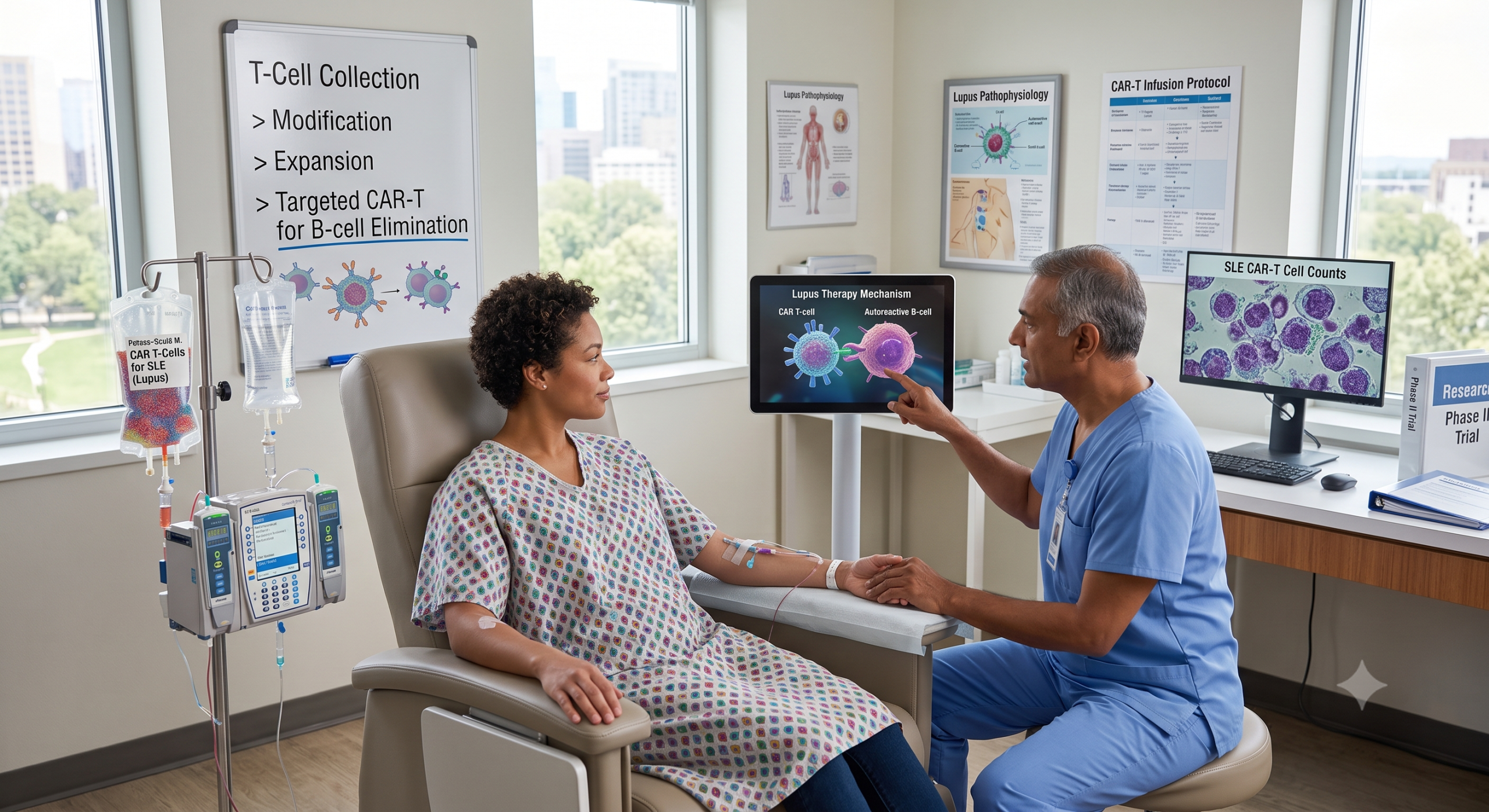
Lupus is one of the hardest diseases I treat. It can attack the skin, joints, kidneys, brain, blood, and lungs — often all in the same person — and while our medications have gotten much better, they mostly control lupus. They don’t cure it, and for some patients the disease keeps flaring no matter what we throw at it.
That’s why a newer therapy has my whole field paying attention. It’s called CAR-T cell therapy, and in patients with severe, treatment-resistant lupus, it has done something we’ve almost never seen: pushed the disease into deep, drug-free remission after a single treatment — sometimes clearing lupus even from the kidneys.
I’m Dr. Diana Girnita, a double board-certified rheumatologist with a PhD in immunology. Let me walk you through the honest version — what makes lupus so stubborn, what CAR-T actually does, what the lupus studies really show, and why cautious hope is the right frame.
Why is severe lupus so hard to treat?
Lupus — systemic lupus erythematosus (SLE) — is driven largely by misbehaving B cells. In lupus, B cells churn out autoantibodies, including anti-double-stranded DNA (anti-dsDNA), that attack your own tissues and organs. When those antibodies and immune complexes settle in the kidneys, you get lupus nephritis, one of the most dangerous complications, capable of leading to kidney failure.
We have real tools: steroids, hydroxychloroquine, mycophenolate, and newer biologics like belimumab and anifrolumab, plus rituximab in some cases. These save lives. But they share two limits — they usually require ongoing treatment, and in a subset of patients the disease simply refuses to quiet down. For those patients, we’ve long needed something that targets the source of the problem rather than just suppressing it.
What is CAR-T cell therapy, in plain terms?
CAR-T stands for chimeric antigen receptor T-cell therapy. Doctors collect your own immune T cells, reprogram them in a lab to recognize and destroy the B cells driving your lupus (by targeting a B-cell marker called CD19), grow millions of copies, and infuse them back into you.
What makes it different from older drugs is depth. These reprogrammed cells track down B cells not just in the blood, but in the lymph nodes, bone marrow, and inflamed tissues where lupus hides. When your B cells later regrow, they come back “naive” — without the memory of attacking you. Researchers call this an immune reset. I explain the full step-by-step process and the other conditions it’s used for in my complete guide to CAR-T for autoimmune disease.
What does the research show for CAR-T in lupus?
Lupus is actually where this whole story began — and the results have been striking.
The first patient (2021). German researchers treated a 20-year-old woman with severe, refractory lupus using a single anti-CD19 CAR-T infusion. Within weeks, her autoantibodies became undetectable and her disease activity normalized. It was the first time CAR-T had been used for lupus, and it opened the door.
The landmark series (2022). In a study published in Nature Medicine (Mackensen and colleagues), five patients with treatment-resistant lupus each received one CAR-T infusion. All five reached DORIS remission (a strict definition of lupus remission) within three months, their anti-dsDNA antibodies seroconverted to negative, their nephritis stopped, and — remarkably — they were able to stop all immunosuppressive medications. The remission held even after their B cells grew back, because the new B cells returned naive. Side effects were limited to mild cytokine release syndrome.
Longer follow-up (2024). A larger case series in the New England Journal of Medicine followed 15 patients across lupus and other autoimmune diseases, reporting sustained drug-free remission over a median of about 15 months.
The most rigorous data yet (2026). The CASTLE basket trial, published in Nature Medicine, tested a CD19 CAR-T product in treatment-refractory lupus, scleroderma, and myositis. In the lupus arm, 9 of 10 patients reached DORIS remission. Every lupus patient’s anti-dsDNA antibodies seroconverted to negative within six months, their disease activity scores fell essentially to zero, and all patients came off glucocorticoids and other immunosuppressants. These were people who had already failed multiple prior therapies.
Can CAR-T cell therapy help lupus nephritis?
This is one of the most encouraging parts. Lupus nephritis — lupus attacking the kidneys — is exactly the kind of organ-threatening disease we most want to stop.
In the CASTLE trial, the two lupus nephritis patients had kidney biopsies showing no active nephritis after treatment, and both stayed drug-free within 18 months of follow-up. In the earlier Mackensen series, nephritis ceased and complement levels normalized. Because CAR-T reaches B cells in tissues, not just blood, it’s being actively studied for kidney lupus — including in dedicated trials in the United States such as the RESET-SLE program, which enrolls patients with lupus nephritis and non-renal lupus.
How is CAR-T cell therapy different from rituximab or belimumab?
Many lupus patients have already tried B-cell drugs, so this comparison matters.
| Rituximab / Belimumab | CD19 CAR-T | |
|---|---|---|
| What it is | Antibody medications (repeated dosing) | Your own reprogrammed T cells (single infusion) |
| Target | CD20 (rituximab) / BAFF (belimumab) | CD19 — a broader range of B cells |
| Where it works | Mostly the bloodstream | Blood and deep tissues, lymph nodes, kidney |
| Goal | Suppress B-cell activity | Reset the B-cell system |
| Duration | Ongoing | Aims for lasting, drug-free remission |
The telling detail: many CAR-T responders had already failed rituximab. Rituximab suppresses; CAR-T aims to reset.
Where is lupus CAR-T cell research heading?
The field is moving quickly, and a few directions stand out:
- Hitting the deeper factories. Some autoantibodies come from long-lived plasma cells that CD19 alone may miss. A 2025 phase 1 trial tested dual CD19 + BCMA CAR-T in refractory lupus to target both B cells and those plasma cells, with most patients reaching remission by three months.
- “Off-the-shelf” CAR-T. Allogeneic CAR-T made from healthy donor cells has induced remission in refractory lupus, with one patient in sustained, medication-free remission — a route that could one day lower cost and wait times.
- A wave of trials. Dozens of CAR-T lupus trials are now underway worldwide, with lupus and lupus nephritis among the most-studied targets.
Is CAR-T cell therapy a cure for lupus?
Not yet — and I want to be careful here. Here’s the honest picture:
- It has produced drug-free remission in severe, refractory lupus patients, including clearing kidney disease — something we rarely achieve.
- But the numbers are still small, follow-up is months to a few years, and it’s reserved for the most treatment-resistant cases.
- It carries real risks (below) and is available essentially only through clinical trials.
Calling it a “cure” would be premature. What I can say is that CAR-T has reopened a question lupus doctors had mostly stopped asking — whether a true, lasting reset is possible — and the early answer is genuinely hopeful.
What are the risks and cautions?
Honesty first:
- Cytokine release syndrome (CRS) and neurotoxicity (ICANS) can occur and require specialized, sometimes ICU-level, monitoring.
- Infection risk while B cells are depleted.
- A boxed warning: the FDA requires a warning about rare secondary T-cell malignancies after CD19- or BCMA-directed CAR-T.
- Very high cost and complex, individualized manufacturing.
- Narrow eligibility — currently the most refractory patients, within trials.
And a caution I repeat often: legitimate CAR-T for lupus is available only through clinical trials at major medical centers — not at wellness clinics or overseas “one-day” centers. I explain how to spot look-alike offers in my main CAR-T article.
The bottom line
Can we reset lupus? For the first time, we have a therapy — CAR-T cell therapy — that has pushed severe, treatment-resistant lupus into deep, drug-free remission in early studies, cleared autoantibodies, and even calmed the kidneys. It’s early, it’s risky, it’s expensive, and it’s limited to clinical trials for the toughest cases. It is not a cure. But it may be the closest science has come to asking whether one is within reach.
If you have severe lupus that has failed multiple treatments, it’s worth asking a rheumatologist whether a clinical trial might be right for you. If your lupus is well controlled, your current treatment is still your best path.
References
- Mougiakakos D, Krönke G, Völkl S, et al. CD19-Targeted CAR T Cells in Refractory Systemic Lupus Erythematosus. N Engl J Med. 2021;385:567-569. Link
- Mackensen A, Müller F, Mougiakakos D, et al. Anti-CD19 CAR T cell therapy for refractory systemic lupus erythematosus. Nat Med. 2022;28:2124-2132. Link
- Müller F, Taubmann J, Bucci L, et al. CD19 CAR T-cell therapy in autoimmune disease — a case series with follow-up. N Engl J Med. 2024;390:687-700. Link
- Müller F, Hagen M, Wirsching A, et al. CD19 CAR-T cells for treatment-refractory autoimmune diseases: the phase 1/2 CASTLE basket trial. Nat Med. 2026. Link
- Co-infusion of CD19-targeting and BCMA-targeting CAR-T cells for treatment-refractory SLE: a phase 1 trial. Nat Med. 2025. Link
- Allogeneic anti-CD19 CAR-T cells induce remission in refractory systemic lupus erythematosus. Cell Research. 2025. Link
This article is for educational purposes and does not constitute medical advice. Do not start, stop, or modify any medication without consulting your physician.
Diana Girnita, MD, PhD, FACR — double board-certified rheumatologist, founder of Rheumatologist OnCall (telehealth practice serving women across multiple US states, in person in California), PhD in immunology.
Author
Frequent asked questions
Can lupus be cured with CAR-T therapy?
Not proven yet. CAR-T has produced drug-free remission in severe, refractory lupus in early studies, but the numbers are small and follow-up is limited. It's promising, not a confirmed cure.
How well does CAR-T work for lupus?
Very well in early studies of refractory patients: in the landmark 2022 series all five patients reached remission and stopped medications, and in the 2026 CASTLE trial 9 of 10 lupus patients reached DORIS remission with anti-dsDNA antibodies turning negative.
Does CAR-T work for lupus nephritis?
Encouragingly, yes, in early data. Kidney biopsies in the CASTLE trial showed no active nephritis after treatment, and dedicated lupus nephritis trials are underway.
Who qualifies for CAR-T for lupus?
Right now, mainly patients with severe, treatment-refractory lupus who have failed multiple therapies — and generally only within clinical trials. Well-controlled lupus is not an indication.
Is CAR-T better than rituximab or belimumab for lupus?
They work differently. Rituximab and belimumab suppress B cells mainly in the blood and require ongoing dosing; CD19 CAR-T reaches B cells in deep tissues and aims for a one-time reset. Many CAR-T responders had already failed rituximab.
How long does remission last after CAR-T for lupus?
Follow-up so far runs from several months to a few years, with drug-free remission maintained in many patients. Truly long-term durability is still being studied.
What are the side effects of CAR-T for lupus?
Cytokine release syndrome, neurotoxicity, infection risk, and a boxed warning for rare secondary T-cell cancers. It requires close monitoring.
Do lupus autoantibodies come back after CAR-T?
In studies, anti-dsDNA antibodies became negative and often stayed negative even after B cells regrew — because the new B cells return "naive," without the autoimmune memory.
Is CAR-T for lupus available now?
Only through clinical trials at specialized centers, including US programs studying lupus and lupus nephritis. It is not yet an approved, routine lupus treatment.
Should I stop my lupus medication because of CAR-T?
No. Never start, stop, or change lupus medication without your physician. CAR-T is investigational and limited to a narrow group; your current treatment remains your best path if it's working.