For decades, patients with severe autoimmune diseases like lupus, scleroderma, and myositis have lived with a frustrating reality: even our best medications often only control symptoms. They rarely cure. And for some patients, the disease keeps flaring no matter what we try. CAR-T cell therapy for autoimmune disease is changing that conversation — offering, for the first time, the possibility of a true immune “reset.”
As a rheumatologist, I want to walk you through what this therapy is, how it works, which diseases it may help, what it costs, and — just as importantly — how to protect yourself from clinics offering something that only looks like CAR-T. The science here is genuinely exciting, but it deserves to be explained honestly.
What Is CAR-T Cell Therapy?
To understand CAR-T cell therapy for autoimmune disease, it helps to start with how your immune system works.
Your immune system is the army that protects your body from infections. The immune system has two key players that matter here. T cells are the soldiers. B cells are the factories — they produce antibodies, the weapons your body uses against invaders. In normal people, T cells communicate with B cells and send signals when needed to produce antibodies.
However, in autoimmune disease, the B cells get activated by something we don’t fully understand — sometimes a virus, sometimes genetics, sometimes an environmental trigger. They start producing antibodies that attack your own body: your skin, your joints, your lungs, your kidneys. Normally, your T cells should stop this. But in autoimmune disease, they don’t recognize the problem, so the attack continues.
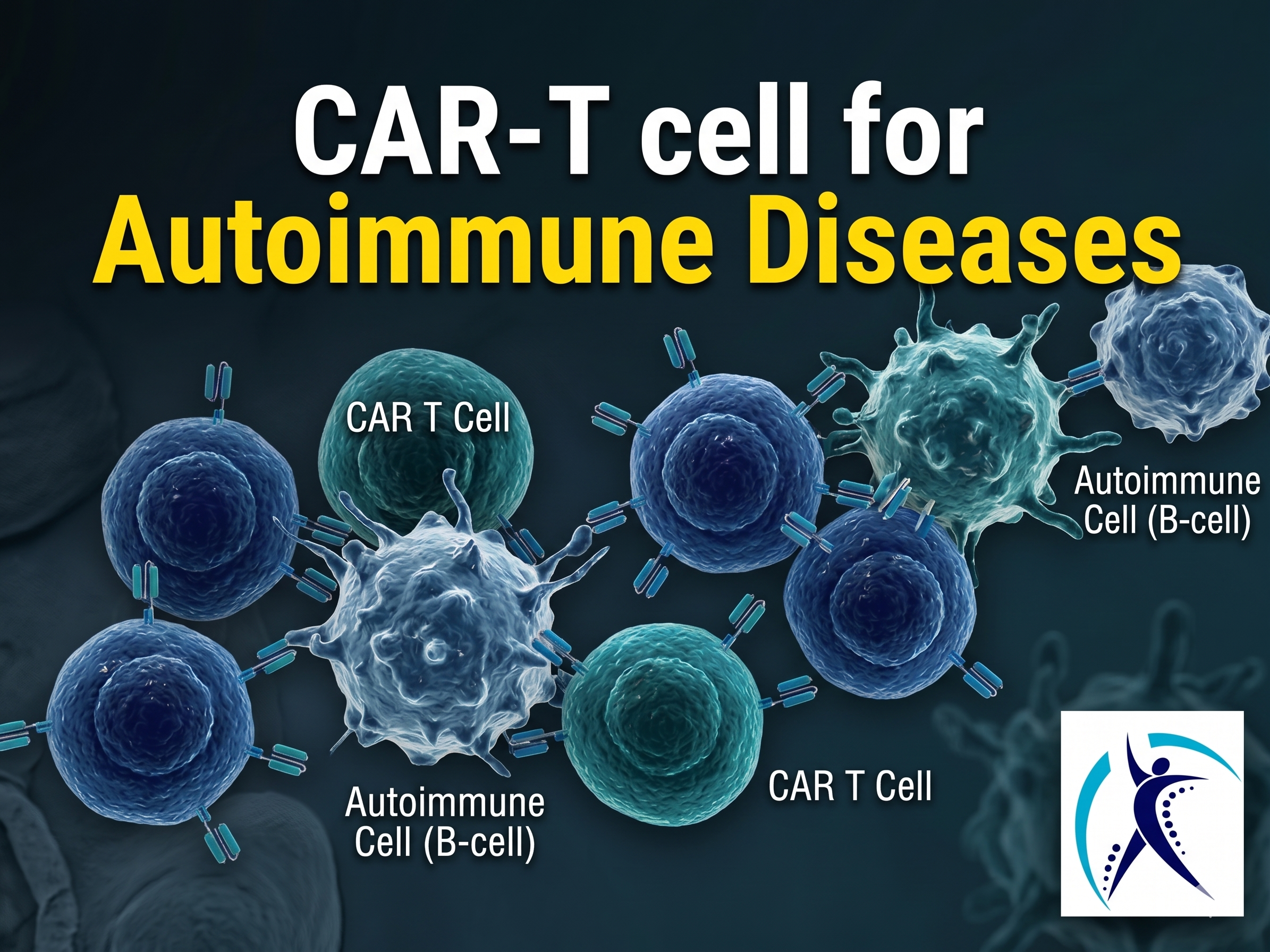
CAR-T cell therapy fixes that. CAR stands for chimeric antigen receptor. It is a treatment that reprograms your own T cells to recognize and eliminate the problematic B cells. What makes this so powerful is that these reengineered T cells find the bad B cells not only in your blood but also in those hiding deep in your tissues, lymph nodes, and bone marrow — places older therapies struggle to reach.
How Does CAR-T Cell Therapy Work? Five Steps
Here is how the process works, step by step.
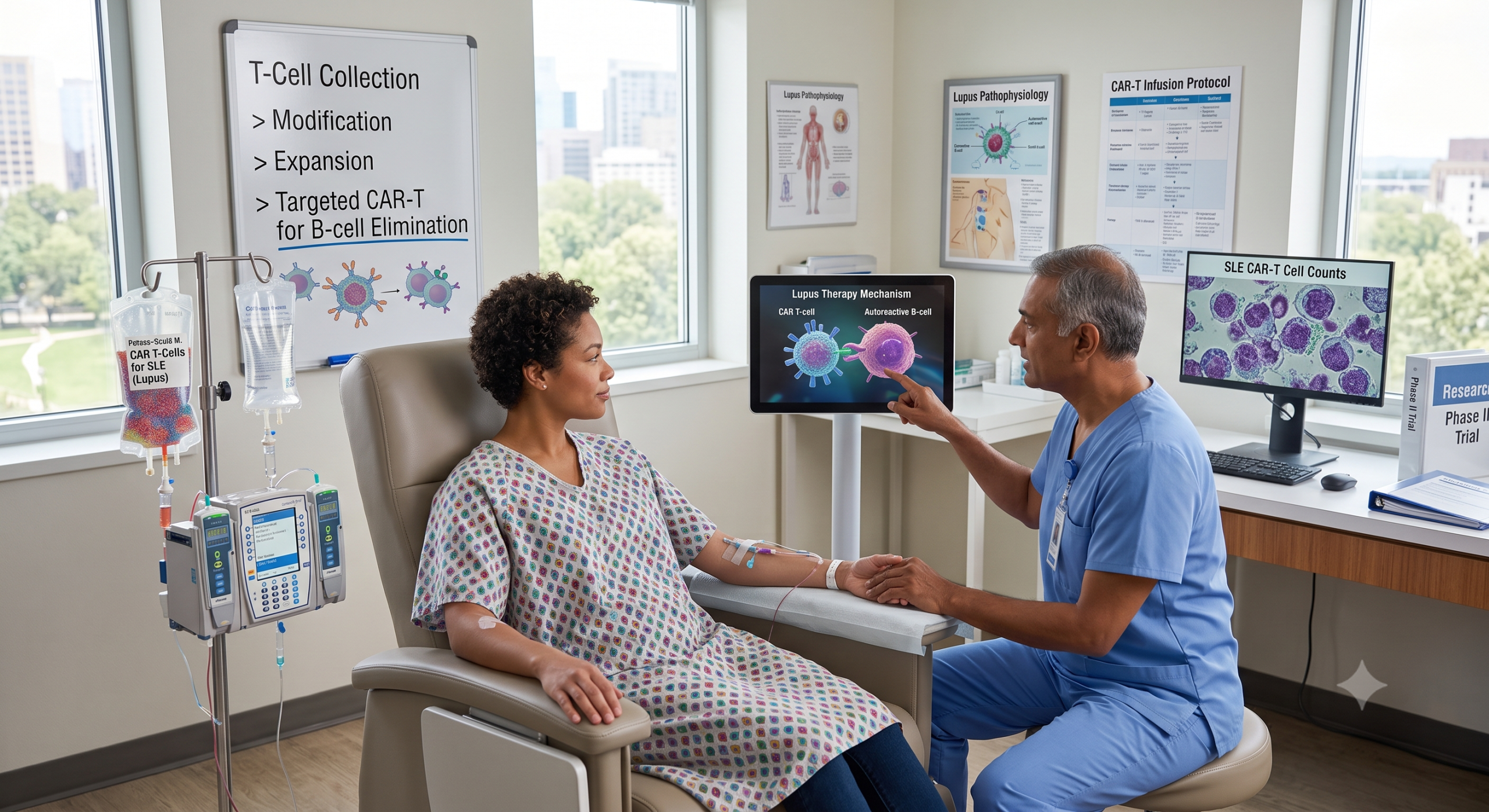
Step one — collection. Doctors take a blood sample and isolate your T cells.
Step two — engineering. In a specialized laboratory, scientists install a small receptor on the surface of those T cells — the chimeric antigen receptor. This teaches your T cells to recognize a marker called CD19, which sits on the surface of B cells.
Step three — expansion. The reprogrammed T cells are multiplied in the lab over roughly two to four weeks, until there are millions of copies.
Step four — preparation. Before the infusion, you receive a short course of treatment that helps your body make room for the new cells.
Step five — infusion. Your reprogrammed T cells are returned to you through an IV. Once inside, they seek out the problematic B cells — in your blood and your tissues — and stop them from producing autoantibodies.
The result is what researchers describe as an immune “reset.” When your B cells eventually grow back, they return naive — without the memory of attacking your own body.
Can CAR-T Cell Therapy Help Severe Lupus?
Lupus is one of the most complex autoimmune diseases, capable of attacking the skin, joints, kidneys, brain, and lungs. For decades, we have treated it with steroids, hydroxychloroquine, mycophenolate, and biologics. These save lives — but for some patients, the disease keeps flaring regardless.
The landmark work came from researchers in Germany. In a study published in Nature Medicine in 2022, patients with severe, treatment-resistant lupus each received a single infusion of CD19-targeted CAR-T cells. Within weeks, symptoms began to disappear and autoantibodies — including anti-double-stranded DNA — vanished. Remarkably, patients were able to stop all of their immunosuppressive medications. A subsequent case series with longer follow-up, published in the New England Journal of Medicine in 2024, reported that these patients across several autoimmune diseases sustained drug-free remission over extended follow-up.
The most rigorous data to date come from the CASTLE basket trial, published in Nature Medicine in January 2026. In the lupus arm of that study, 9 of 10 patients with treatment-refractory disease achieved formal remission (DORIS criteria) after a single CAR-T infusion, their anti-double-stranded DNA antibodies became negative, and all patients remained free of glucocorticoids and other immunosuppressants throughout follow-up. These were patients who had already failed a median of four prior therapies.
I want to be honest with you: this therapy is currently reserved for patients with severe disease that has not responded to standard treatments. If you are stable on your current medications, this is not for you yet. But if you have exhausted your options, this may represent real hope.
Can CAR-T Cell Therapy Help Scleroderma?
Scleroderma — or systemic sclerosis — causes the skin and internal organs to become stiff and scarred. The most dangerous feature is interstitial lung disease, which can slowly rob patients of their ability to breathe. We have very few treatments that meaningfully reverse this damage.
CD19-targeted CAR-T therapy has now been studied in patients with severe, treatment-resistant scleroderma, including those with active lung involvement. In a case series of patients with diffuse systemic sclerosis published in The Lancet Rheumatology in 2025, skin thickening softened, and disease activity improved after treatment. The CASTLE trial reinforced this: in its scleroderma arm, all 9 patients showed no progression of lung disease, and — strikingly — lung function actually improved, with skin scores falling by roughly half. Scleroderma has long been one of the hardest autoimmune diseases to treat, which makes responses like these notable.
As with lupus, this approach is currently for patients with severe scleroderma that has failed standard treatments — including mycophenolate, cyclophosphamide, and biologics. For patients with progressive disease and no remaining options, it is an avenue worth discussing with a specialist.
Can CAR-T Cell Therapy Help Inflammatory Myositis?
Inflammatory myositis is a group of autoimmune diseases — including dermatomyositis, polymyositis, and anti-synthetase syndrome — that attack the muscles. Patients lose strength, struggle to lift their arms or climb stairs, and in many cases develop interstitial lung disease as well.
We treat myositis with steroids, methotrexate, mycophenolate, IVIG, and rituximab. For most patients, these help, but some continue to progress despite everything. CD19-targeted CAR-T therapy has shown encouraging results in refractory myositis. In the CASTLE trial, 4 of 5 patients with treatment-refractory disease reached a meaningful clinical response (ACR moderate or major response), with improvements in muscle strength and normalization of muscle enzymes. Researchers have even reported using BCMA-targeted CAR-T cells in a patient with relapsing myositis after prior CD19 CAR-T therapy, a case reported in Nature Medicine in 2025 — an early signal that re-treatment strategies may be possible.
Can Longer Follow-Up Tell Us How Long CAR-T Lasts?
This is the question every patient asks. Here is what the data currently show.
The CAR-T cells themselves disappear from your body within about three months. That is expected — they are not meant to stay forever. What persists is the immune system’s reset. Your B cells grow back, but without the memory of attacking you, and the autoantibodies stay gone.
In the original German studies, patients with lupus, scleroderma, and inflammatory myositis who received a single infusion have now been followed for over three years and remain in drug-free remission. That said, we still do not know what happens at year five, year ten, or beyond. Some patients may eventually need a second infusion; some may not. The follow-up is still relatively short. But one treatment producing multiple years of remission — in diseases that used to flare every few months — is something we have never seen before.
CAR-T vs. Rituximab: What Is the Difference?
Patients ask me this constantly. Rituximab is a medication — an antibody infusion that targets a marker called CD20 on B cells. It has helped countless patients with lupus, vasculitis, and rheumatoid arthritis. But it has a real limitation: it works mostly in the bloodstream and struggles to reach B cells hiding in lymph nodes, the spleen, and inflamed tissues. Long-lived plasma cells producing autoantibodies are often invisible to it.
CAR-T is different. It uses your own reprogrammed T cells, which migrate into tissues that rituximab cannot reach, and it targets CD19, which is expressed on a broader range of B cells. Tellingly, many patients in the CAR-T trials had already failed rituximab, yet still reached drug-free remission. In short: rituximab suppresses the immune system, while CAR-T aims to reset it.
Can CAR-T Cell Therapy Help Rheumatoid Arthritis?
Rheumatoid arthritis is the most common autoimmune disease I treat. For most patients, current treatments — methotrexate, biologics, JAK inhibitors — work well. But a small group of patients has refractory disease that resists multiple therapies while their joints continue to be damaged.
For these patients, CAR-T cell therapy is now being studied. Early case reports, including a report of CD19 CAR-T cells in polyrefractory rheumatoid arthritis published in Annals of the Rheumatic Diseases in 2025, have shown reductions in disease activity and autoantibody levels. Larger trials are underway. If your RA is controlled, CAR-T is not for you. But if you have severe, refractory disease, it may be worth discussing with your rheumatologist.
CAR-T Cell Therapy for Sjögren’s Syndrome
Sjögren’s syndrome attacks the moisture-producing glands, causing dry eyes, dry mouth, and dry skin — but it is also systemic, capable of affecting the joints, lungs, nerves, and kidneys. Current treatments help with symptoms but do not stop the underlying attack, which is driven by B cells producing anti-SSA and anti-SSB autoantibodies.
CAR-T therapy is just beginning to be studied in Sjögren’s, with early reports suggesting B-cell depletion can reduce inflammation and improve gland function. Larger trials are now starting. It is not yet available outside of clinical trials, and if your disease is mild, current treatments remain your best option.
CAR-T Cell Therapy for Vasculitis
ANCA-associated vasculitis is a serious autoimmune disease that inflames blood vessels, affecting the kidneys, lungs, and sinuses. Standard treatments — steroids, cyclophosphamide, rituximab — work for most patients, but some relapse repeatedly. Early single-patient reports have been encouraging, with patients achieving remission and ANCA autoantibodies becoming undetectable. Larger trials are being planned.
How Much Does CAR-T Cell Therapy Cost?
For cancer in the United States, CAR-T currently costs between roughly $400,000 and over $600,000 per patient, with total treatment costs sometimes exceeding $1 million once hospitalization and monitoring are included. Why so expensive? Because every dose is manufactured individually from your own cells — there is no mass production.
Here is what matters most for autoimmune patients: CAR-T for autoimmune disease is currently available only through clinical trials, and in trials the sponsor usually covers the cost of the therapy. This is one of the few times patients can access cutting-edge treatment without an enormous financial burden. Looking ahead, “off-the-shelf” allogeneic CAR-T — made from healthy donor cells and stored ready to use — is in development and could substantially lower costs in the coming years.
A Word of Caution: Overseas Clinics Offering CAR-T
I need to be direct about something important. There are clinics outside the United States advertising CAR-T cell therapy for autoimmune disease — in Mexico, parts of Asia, and some private European centers — for around $200,000. Patients with severe disease are desperate, and I understand that. But you deserve the truth.
Real CAR-T cell therapy requires specialized manufacturing facilities with clean rooms certified for cellular therapy, highly trained staff, and intensive monitoring for two to three weeks after infusion — including the ability to manage cytokine release syndrome in an ICU. If someone offers you CAR-T at a wellness clinic, a private “stem cell center,” or as a one-day outpatient procedure, it is not the real therapy. It may be something entirely untested that could harm you.
In 2026, legitimate CAR-T for autoimmune disease is available only through clinical trials at major academic medical centers. ClinicalTrials.gov is where you find them. Protect yourself, ask hard questions, and remember: real medicine takes time.
The Bottom Line
CAR-T cell therapy represents one of the most promising frontiers in the treatment of severe autoimmune disease. A recent review in Nature Medicine (Schett & Xu, 2026) describes how this approach achieves “deep” B-cell depletion and an immune reset that older therapies simply cannot, and a 2026 commentary in Nature Reviews Drug Discovery outlines the work still needed to bring these therapies to more patients safely and affordably. For patients with refractory lupus, scleroderma, myositis, and a growing list of other conditions, it offers something we have rarely been able to offer: the realistic hope of lasting, drug-free remission.
But it is not for everyone — at least not yet. If your disease is well controlled, your current treatment remains your best path. If you have exhausted standard options, talk to a rheumatologist about whether a clinical trial may be right for you.
If you’d like guidance navigating your options, our team at Rheumatologist OnCall is here to help.
References
- Mackensen, A. et al. Anti-CD19 CAR T cell therapy for refractory systemic lupus erythematosus. Nature Medicine 28, 2124–2132 (2022). https://doi.org/10.1038/s41591-022-02017-5
- Müller, F. et al. CD19 CAR T-cell therapy in autoimmune disease — a case series with follow-up. New England Journal of Medicine 390, 687–700 (2024). https://doi.org/10.1056/NEJMoa2308917
- Müller, F., Hagen, M., Wirsching, A. et al. CD19 CAR-T cells for treatment-refractory autoimmune diseases: the phase 1/2 CASTLE basket trial. Nature Medicine 32, 1142–1151 (2026). https://doi.org/10.1038/s41591-025-04185-6
- Schett, G. & Xu, H. Resetting autoimmune disease with CAR cell therapies. Nature Medicine (2026). https://doi.org/10.1038/s41591-026-04430-6
- Binder, G. K. & Ognar, R. Realizing the promise of CAR-T cell therapies for autoimmune diseases. Nature Reviews Drug Discovery (2026). https://doi.org/10.1038/d41573-026-00062-0
- Auth, J. et al. CD19-targeting CAR T-cell therapy in patients with diffuse systemic sclerosis: a case series. The Lancet Rheumatology 7, 83–93 (2025). https://doi.org/10.1016/S2665-9913(24)00282-0
- Müller, F. et al. BCMA CAR T cells in a patient with relapsing idiopathic inflammatory myositis after initial and repeat therapy with CD19 CAR T cells. Nature Medicine 31, 1793–1797 (2025). https://doi.org/10.1038/s41591-025-03718-3
- Lidar, M. et al. CD-19 CAR-T cells for polyrefractory rheumatoid arthritis. Annals of the Rheumatic Diseases 84, 370–372 (2025). https://doi.org/10.1136/ard-2024-226437
- Bergmann, C. et al. Treatment of a patient with severe systemic sclerosis using CD19-targeted CAR T cells. Annals of the Rheumatic Diseases 82, 1117–1120 (2023). https://doi.org/10.1136/ard-2023-223952
Medical disclaimer: This article is for educational purposes and does not constitute medical advice. Do not start, stop, or modify any medication without consulting your physician.
Diana Girnita, MD, PhD, FACR is a double board-certified rheumatologist and the founder of Rheumatologist OnCall, a virtual rheumatology practice serving women across multiple states. She holds a PhD in immunology and has dedicated her career to helping patients who have been dismissed by the conventional system finally get answers.
Author
Frequent asked questions
What is CAR-T cell therapy for autoimmune disease?
It is a treatment that reprograms your own T cells to recognize and destroy the B cells driving your autoimmune disease, aiming to "reset" the immune system rather than simply suppress it.
How does CAR-T cell therapy work?
CAR-T therapy works in several steps. Doctors collect the patient’s T cells, modify them in a specialized laboratory so they can recognize a marker on B cells, multiply them, prepare the body for infusion, and then return the reprogrammed cells through an IV. Once inside the body, these cells seek out and eliminate problematic B cells.
Why is CAR-T cell therapy called an immune reset?
It is called an immune reset because CAR-T cells remove the B cells that are driving autoantibody production. When B cells eventually grow back, researchers believe they may return without the same autoimmune memory, which may allow some patients to enter long-term remission without ongoing immunosuppressive medication.
Which autoimmune diseases are being studied with CAR-T cell therapy?
CAR-T cell therapy is being studied in severe autoimmune diseases such as lupus, systemic sclerosis, inflammatory myositis, rheumatoid arthritis, Sjögren’s disease, and vasculitis. The most advanced research currently involves treatment-resistant lupus, scleroderma, and inflammatory myositis.
Can CAR-T cell therapy help severe lupus?
CAR-T cell therapy has shown promising results in patients with severe, treatment-resistant lupus. The article explains that patients in early studies and the CASTLE trial achieved remission after a single CAR-T infusion, with autoantibodies becoming negative and patients remaining free of steroids and other immunosuppressive medications during follow-up.
Can CAR-T cell therapy help scleroderma?
CAR-T cell therapy is being studied in severe systemic sclerosis, also called scleroderma. The article notes that patients with treatment-resistant scleroderma showed improvements in skin thickening, disease activity, and lung involvement in early studies and trial data. This approach is currently considered only for severe cases that have failed standard treatment.
Can CAR-T cell therapy help inflammatory myositis?
CAR-T cell therapy has shown encouraging results in treatment-resistant inflammatory myositis, including conditions such as dermatomyositis, polymyositis, and anti-synthetase syndrome. In the article, trial data showed improvements in muscle strength, clinical response, and muscle enzyme levels in some patients.
Can CAR-T cell therapy help rheumatoid arthritis?
CAR-T cell therapy is being studied for severe, refractory rheumatoid arthritis. The article explains that most patients with rheumatoid arthritis respond to current treatments, but a small group with disease that resists multiple therapies may become candidates for clinical research involving CAR-T therapy.
Can CAR-T cell therapy help Sjögren’s disease?
CAR-T cell therapy is only beginning to be studied in Sjögren’s disease. The article notes that early reports suggest B-cell depletion may reduce inflammation and potentially improve gland function, but larger trials are needed. It is not currently available as a standard treatment for Sjögren’s disease outside clinical trials.
How is CAR-T different from rituximab?
Rituximab is an antibody infusion that targets CD20 on B cells and works mainly in the bloodstream. CAR-T therapy uses the patient’s own reprogrammed T cells to target CD19 on a broader range of B cells and may reach immune cells hiding in tissues, lymph nodes, and bone marrow. The article describes rituximab as immune suppression and CAR-T as a potential immune reset.
How long can remission last after CAR-T cell therapy?
The article explains that some patients from early studies have remained in drug-free remission for more than three years after a single infusion. However, longer-term outcomes are still unknown, including what happens at five years, ten years, or beyond. Some patients may eventually need additional treatment, and more follow-up is needed.
Is CAR-T cell therapy available now for autoimmune disease?
In 2026, legitimate CAR-T cell therapy for autoimmune disease is available only through clinical trials at major academic medical centers. It is not yet a standard commercially available treatment for autoimmune disease, and it is currently reserved for severe cases that have not responded to standard therapies.
How much does CAR-T cell therapy cost?
For cancer treatment in the United States, CAR-T therapy can cost hundreds of thousands of dollars, and total costs may exceed $1 million when hospitalization and monitoring are included. For autoimmune disease, access is currently mainly through clinical trials, where the sponsor usually covers the cost of the therapy.
Should patients be cautious about overseas clinics offering CAR-T?
Yes. The article strongly warns patients to be cautious about clinics outside the United States or private wellness centers advertising CAR-T therapy for autoimmune disease. Real CAR-T therapy requires specialized manufacturing, certified cellular therapy facilities, trained teams, and intensive monitoring for serious complications. Patients should verify legitimate clinical trials through trusted medical centers.
Can Rheumatologist OnCall help patients understand CAR-T options?
Yes. Rheumatologist OnCall can help patients with severe autoimmune disease understand whether CAR-T therapy may be relevant to their situation, review current treatment history, explain available research, and guide them on whether discussing clinical trial options with a specialist may be appropriate.