Three years ago, a patient I’ll call Daniel walked into my office. He was 33, weighed 280 pounds, and had been fighting psoriasis and psoriatic arthritis for a decade.
Daniel had failed multiple biologics. I had him on a weight-based biologic infusion — and even that wasn’t giving him adequate control. He was in pain every day. His skin was a mess. At one of our visits, he looked at me and said, “Doc, I’m running out of options.”
So I prescribed him a medication that everyone today is calling “a weight loss drug.”
Six months later, his disease was better controlled than it had been in ten years. His skin cleared up. His joints stopped aching. His morning stiffness was gone. And the biologic that had barely been touching his disease finally started working the way it was designed to.
That’s the story I want to share with you. But it isn’t really about Ozempic. It’s about something almost no one in rheumatology is publicly discussing yet — microdosing GLP-1 medications for psoriatic arthritis.
In the next few minutes, I’ll walk you through what microdosing means, who it’s helping, what the 2025 research actually shows, and the questions my patients ask me about this every single week.
Can Ozempic Help Psoriatic Arthritis?
Yes — and not only because of weight loss. Ozempic and the broader family of GLP-1 medications appear to lower inflammation directly. In my own practice, patients with psoriatic arthritis (PsA) have seen reduced joint pain, fewer flares, lower CRP, and better response to their existing biologic after starting a GLP-1.
That clinical pattern is now backed by data. At ACR Convergence 2025, researchers from Toronto and NYU reported that PsA patients starting GLP-1 receptor agonists had significant improvements in joint counts, CRP, pain scores, and DAPSA disease activity scores within one year of treatment.¹
What’s interesting is that you don’t seem to need a large dose to see these benefits. Which is what brings us to microdosing.
What Is Microdosing Ozempic?
Microdosing means using a much smaller dose of a GLP-1 medication than what’s typically prescribed for diabetes or weight loss — often a fraction of the standard starting dose. The goal isn’t appetite suppression or significant weight loss. The goal is calming the chronic inflammation that drives autoimmune disease.
I want to be direct here: this isn’t the version of Ozempic you see on social media. This isn’t about getting skinny. It’s about using a known anti-inflammatory effect of these drugs at the lowest dose that meaningfully improves disease control.
I started using this approach in my clinic not to chase a trend, but because I had patients who didn’t need to lose weight yet clearly had inflammation driving their joint pain and flares. They needed something to break the cycle.
How Microdosing Differs From Standard GLP-1 Use
| Standard Dose (Weight Loss / Diabetes) | Microdose (Inflammation Focus) | |
|---|---|---|
| Goal | Significant weight loss, blood sugar control | Reduce systemic inflammation |
| Dose | Full FDA-approved titration | Fraction of standard starting dose |
| Appetite effect | Strong suppression | Minimal |
| Best candidate | Obese or diabetic patient | Patient with active disease despite full treatment |
Why Would a “Weight Loss Drug” Affect Arthritis at All?
This is the most important question my patients ask, and the answer changes how you think about your disease.
Your fat tissue isn’t sitting quietly in storage. It’s biologically active. It produces a steady stream of inflammatory chemicals — IL-6, TNF-alpha, IL-17. Those are the exact same molecules that drive psoriatic arthritis, rheumatoid arthritis, and lupus. They’re the same molecules your biologic is designed to block.
Read that again, because it’s the missing piece almost no one explains:
The molecules your $7,000-a-month biologic is designed to neutralize? Your own fat tissue is making them — for free, while you sleep.
This is why, for so many patients with PsA and RA, biologics only work partially. The biologic isn’t failing. The metabolic inflammation coming from fat tissue is undercutting it in real time. And that inflammation doesn’t stop at the joints — it travels to your heart, your blood vessels, and your kidneys.
The Two Mechanisms That Make GLP-1s Work for Arthritis
GLP-1 medications change this in two ways:
1. They shut down the fat-tissue inflammation factory. Even modest weight loss dramatically reduces the cytokine output from adipose tissue.
2. They have a direct anti-inflammatory effect of their own. A 2025 systematic review and meta-analysis in Reviews in Endocrine and Metabolic Disorders found that tirzepatide (the active ingredient in Mounjaro and Zepbound) reduced hsCRP by approximately 33% and IL-6 by approximately 18% compared to placebo — across patients with and without diabetes.² A growing body of research suggests this effect occurs through direct action on the NF-κB pathway, a master switch of inflammation.
That second mechanism is what makes microdosing possible. If the drug works without weight loss, you don’t need a high dose to benefit.
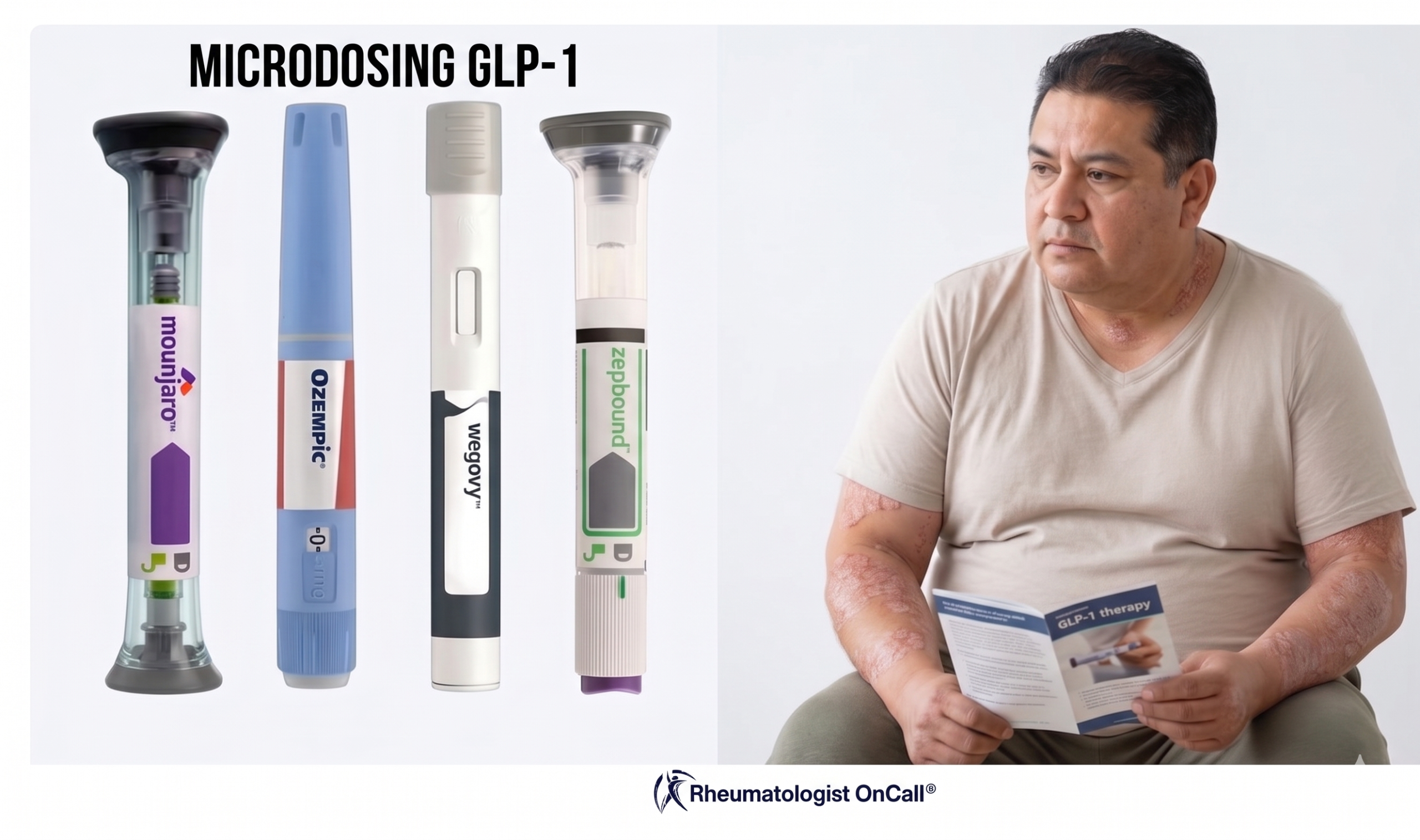
What’s the Difference Between Ozempic, Wegovy, Mounjaro, and Zepbound?
I get this question every week, and it matters because these are not all the same drug.
Semaglutide (Single Receptor)
- Ozempic — FDA-approved for type 2 diabetes
- Wegovy — higher-dose version, FDA-approved for obesity
Semaglutide activates one receptor: GLP-1.
Tirzepatide (Dual Receptor)
- Mounjaro — FDA-approved for type 2 diabetes
- Zepbound — FDA-approved for obesity
Tirzepatide activates two receptors: GLP-1 and GIP. That dual action explains its stronger metabolic and anti-inflammatory effects.²
When I say “GLP-1 medications” in this article, I mean this whole family.
Does Microdosing Ozempic Work if You’re Not Overweight?
This is what surprises my patients most. Yes — it can.
I have a patient in Arizona who isn’t obese. She isn’t even significantly overweight. But her rheumatoid arthritis was out of control. She was on a DMARD and a biologic — both at full doses — and still having multiple flares per month. Exhausted. In pain. She came to me asking, “What else can I do?”
I prescribed her a microdose of a GLP-1. Not for weight loss. For the anti-inflammatory effect.
Four months later, her flares had dropped from multiple per month to one. Her energy returned. Her morning stiffness improved. And we’re actually tapering her medications down, not adding more.
That’s the conversation rheumatology hasn’t had publicly yet. But I’m having it with my patients, and I’m watching it work.
What Does the 2025 Research Say About GLP-1s and Psoriatic Arthritis?
Three studies presented or published in the past year changed how I talk about this in clinic.
1. PsA Disease Activity Improves on GLP-1s
A retrospective study presented at ACR Convergence 2025, led by researchers from the University of Toronto and NYU, followed 48 patients with psoriatic arthritis who started GLP-1 receptor agonists.¹ The findings:
- Significant weight loss (35% of patients lost 5–10% of body weight; 25% lost more than 10%)
- Significant reductions in CRP and triglyceride levels
- Improvement in pain scores
- Improvement in DAPSA (Disease Activity in PsA) scores
- Improvement in patient global assessment
This is exactly what I’d watched happen with Daniel — except now there is published data behind it.
2. GLP-1s May Prevent Rheumatic Disease From Developing
A Harvard-led propensity-matched cohort study, also presented at ACR Convergence 2025 by Dr. Betul Ibis and colleagues, used the TriNetX database to compare 217,302 diabetes patients on GLP-1 medications with 217,302 matched patients on DPP-4 inhibitors.³ Patients on GLP-1s had a significantly lower risk of developing rheumatoid arthritis (HR = 0.87, p = 0.026), gout, and osteoarthritis within one year.
In plain English: this “weight loss drug” may actually prevent certain rheumatic diseases from developing in people at metabolic risk.
3. GLP-1s Reduce Heart Attacks and Mortality in PsA Patients
This is the study that matters most for long-term outcomes. Dr. Nanuka Tsibadze and colleagues at Jefferson Einstein Philadelphia conducted a nationwide retrospective analysis of 4,104 PsA patients on GLP-1s versus 86,432 PsA patients not on GLP-1s.⁴ The results:
- Mortality: 1.4% in the GLP-1 group vs. 4.6% in the non-GLP-1 group
- Significantly lower rates of acute myocardial infarction
- Lower risk of major adverse cardiac events overall
Psoriatic arthritis already raises cardiovascular risk substantially. A medication that lowers that risk doesn’t just treat joint pain — it changes long-term survival.
Who Should NOT Take Ozempic or Other GLP-1 Medications?
Before anyone considers GLP-1 therapy — at any dose — let me be clear about who needs to avoid these medications:
- Personal or family history of medullary thyroid cancer or MEN-2 syndrome — contraindicated
- History of pancreatitis — may not be safe
- Severe gastroparesis — these drugs will worsen it
- Pregnancy or active conception planning — not recommended
These are real medications with real side effects: nausea, vomiting, constipation, gallbladder problems. They are not magic. They are powerful — and powerful means weighing risk against benefit, every time.
This is exactly why this conversation belongs in a rheumatologist’s office. Not a weight loss clinic. Not TikTok. Not Reddit. Someone needs to look at your full picture before this call gets made.
How Do I Ask My Rheumatologist About Microdosing?
If you’re on maximum arthritis treatment and still flaring, here’s what I’d suggest:
- Write down the word “microdosing” before your next visit
- Bring a list of your current medications and your most recent CRP, ESR, and DAPSA (if known)
- Ask directly: “Could a microdose of a GLP-1 medication help my arthritis?”
Some rheumatologists will know exactly what you’re talking about. Some won’t yet — the research is moving faster than the textbooks. Either way, you deserve to ask the question.
If your current rheumatologist isn’t open to the conversation, that’s exactly why I built Rheumatologist OnCall. You’ll see a board-certified rheumatologist in days, not months, via telehealth across 20+ states with no referral required. Your first visit is a full hour and includes a discussion of GLP-1 therapy when it fits your case.
The Bigger Picture
Ozempic, Wegovy, Mounjaro, and Zepbound are not replacing your DMARDs or your biologics. This part is important. But they are emerging as one of the most powerful complements to arthritis treatment we have right now — because they address the metabolic inflammation that conventional rheumatology has not been touching.
UCLA. Harvard. The 2025 ACR data. It all points in the same direction: less joint pain, fewer flares, lower cardiovascular risk, better response to existing medications. And for the right patient, even a microdose can produce real, measurable, life-changing results.
If you’re stuck — if your medications are doing something but not enough, if your flares keep coming, if your fatigue won’t lift — there’s a metabolic piece of your puzzle that probably hasn’t been addressed yet.
That’s the conversation worth having. And it might just be the one that finally moves your disease in the right direction.
About Dr. Diana Girnita
Dr. Diana Girnita, MD, PhD, is a double board-certified rheumatologist and internal medicine specialist with over 20 years of clinical and research experience. She completed her PhD in immunology, her residency in internal medicine, and her rheumatology fellowship at the University of Cincinnati, followed by advanced training at Harvard Medical School.
Dr. Girnita is the founder of Rheumatologist OnCall, the first nationwide telehealth rheumatology practice in the United States, providing patient care across 20+ states with no referral required. She has authored peer-reviewed publications in immunology and rheumatology, lectured internationally, and is the author of Thriving with Rheumatoid Arthritis. Dr. Girnita is one of the first rheumatologists publicly discussing GLP-1 microdosing as an adjunctive strategy for inflammatory arthritis.
She believes patients deserve longer visits, individualized treatment plans, and access to the most current evidence-based therapies — not just what fits the standard 15-minute appointment.
Connect: Rheumatologist OnCall | Book a consultation →
References
- Eder L, Scher U, Chen K, Rice A, Thib S, Haberman R. Glucagon-like peptide-1 receptor agonists therapy is associated in improvement in psoriatic arthritis-related and metabolic outcomes: A retrospective analysis of two cohorts. Arthritis Rheumatol. 2025; 77 (suppl 9). Available at: https://acrabstracts.org/abstract/glucagon-like-peptide-1-receptor-agonists-therapy-is-associated-in-improvement-in-psoriatic-arthritis-related-and-metabolic-outcomes-a-retrospective-analysis-of-two-cohorts/
- Masson W, Lobo M, Nogueira JP, Barbagelata L, Touzas P, Frías JP. Anti-inflammatory effects of tirzepatide: a systematic review and meta-analysis. Reviews in Endocrine and Metabolic Disorders. 2025. https://doi.org/10.1007/s11154-025-09991-4
- Ibis B, et al. GLP-1 receptor agonist therapy and reduced incidence of rheumatic diseases: A propensity score-matched cohort study. Presented at ACR Convergence 2025, Chicago, IL. Healio coverage available at: https://www.healio.com/news/rheumatology/20251030/glp1s-show-clear-signal-of-reduced-rheumatoid-arthritis-gout-osteoarthritis-risks
- Tsibadze N, Tskhakaia I, Tan I. Mortality and Major Adverse Cardiac Events (MACE) with GLP-1 Receptor Agonists in Psoriatic Arthritis. Arthritis Rheumatol. 2025; 77 (suppl 9). Available at: https://acrabstracts.org/abstract/mortality-and-major-adverse-cardiac-events-mace-with-glp-1-receptor-agonists-in-psoriatic-arthritis/
- Buonanno S, Gaggiano C, Terribili R, Cantarini L, Frediani B, Gentileschi S. The potential role of GLP-1 receptor agonists in the management of psoriatic disease: a scoping review. Inflammation Research. 2025. PMC12634801
- Paschou IA, Sali E, Paschou SA, Psaltopoulou T, Nicolaidou E, Stratigos AJ. GLP-1RAs in patients with psoriasis. Hormones (Athens). 2025. PMC12339632
Medical disclaimer: This article is for educational purposes and does not constitute medical advice. GLP-1 medications have specific contraindications and side effects. Do not start, stop, or modify any medication without consulting your physician.
Author
Frequent asked questions
Is microdosing Ozempic FDA-approved for arthritis?
No. Ozempic, Wegovy, Mounjaro, and Zepbound are not FDA-approved specifically for arthritis or autoimmune disease. They are FDA-approved for type 2 diabetes and/or obesity. When rheumatologists use them for inflammatory arthritis, it is considered off-label prescribing — a legal and common practice when supported by emerging clinical evidence and individualized patient need.
What's the typical microdose for arthritis?
There's no standardized microdosing protocol yet — that's part of why this conversation is still emerging. In practice, microdoses are usually a fraction of the standard starting dose (for example, 0.125 mg or 0.25 mg of semaglutide rather than 0.5 mg). The exact dose depends on your weight, comorbidities, kidney function, and disease activity, and should always be determined by your prescribing physician.
Can I take a GLP-1 medication while on a biologic like Humira or Cosentyx?
In most cases, yes. GLP-1 medications are not immunosuppressants and don't share metabolic pathways with biologics. In fact, the goal of combining them is often to make the biologic work better by reducing background inflammation. That said, this combination should always be coordinated with your rheumatologist.
How long until I see results from microdosing?
Most of my patients begin to notice changes in joint pain, morning stiffness, or fatigue within 8 to 12 weeks. CRP often drops within 12 to 16 weeks. The cardiovascular and disease-modifying benefits seen in the 2025 studies typically emerge over months to a year of consistent use.
Will insurance cover Ozempic for arthritis?
Coverage for off-label use is challenging. Most insurance plans cover GLP-1 medications only when prescribed for diabetes or, in some cases, obesity with specific BMI criteria. Many of my patients use compounded semaglutide or tirzepatide through specialty pharmacies, or pay out of pocket for branded medications. This is one of the most common barriers, and we discuss options at the first visit.
Is microdosing Ozempic safe long-term?
The long-term data on standard-dose GLP-1 medications continues to be reassuring — most cardiovascular and renal outcome trials now extend out 3 to 5 years. Microdosing is theoretically safer because the dose is lower. But long-term, microdose-specific data is still being collected, which is why these decisions need to be individualized.
Does microdosing Ozempic cause weight loss?
Usually no — or very little. The whole point of microdosing is to use a dose low enough that appetite suppression and significant weight loss don't occur. Patients who do not need to lose weight typically maintain stable weight on a microdose.