Three years ago, a patient I’ll call Daniel walked into my office. He was 33 years old, and he had been fighting psoriasis and psoriatic arthritis for a decade. He carried extra weight. He had tried five different biologic medications, and every one of them had eventually let him down. When I met him, he was on a Simponi infusion dosed to his body weight — and he was still struggling every single day.
I did something a little different for Daniel. Instead of reaching for a sixth biologic, I started him on Ozempic, because I had come to believe his metabolic problem was a huge part of why nothing was working.
Six months later, his disease was more controlled than it had been in ten years. One year later, his psoriasis had almost completely disappeared. Today, he lives a normal life.
So when patients ask me whether GLP-1 medications like Ozempic can help psoriasis and psoriatic arthritis, I don’t answer from a textbook. I answer from what I’ve watched happen in my own clinic. Here’s the honest version.
(Daniel’s story is a real, anonymized case. Individual results vary, and no medication works the same way for everyone.)
Can GLP-1 medications treat psoriasis and psoriatic arthritis?
Yes — GLP-1 medications can meaningfully help psoriasis and psoriatic arthritis, but they are not a cure and they do not replace a biologic. What they do is lower inflammation directly. In my patients, I’ve seen lower CRP, fewer flares, and — this is the part that surprised me most — a biologic that finally starts working the way it was designed to.
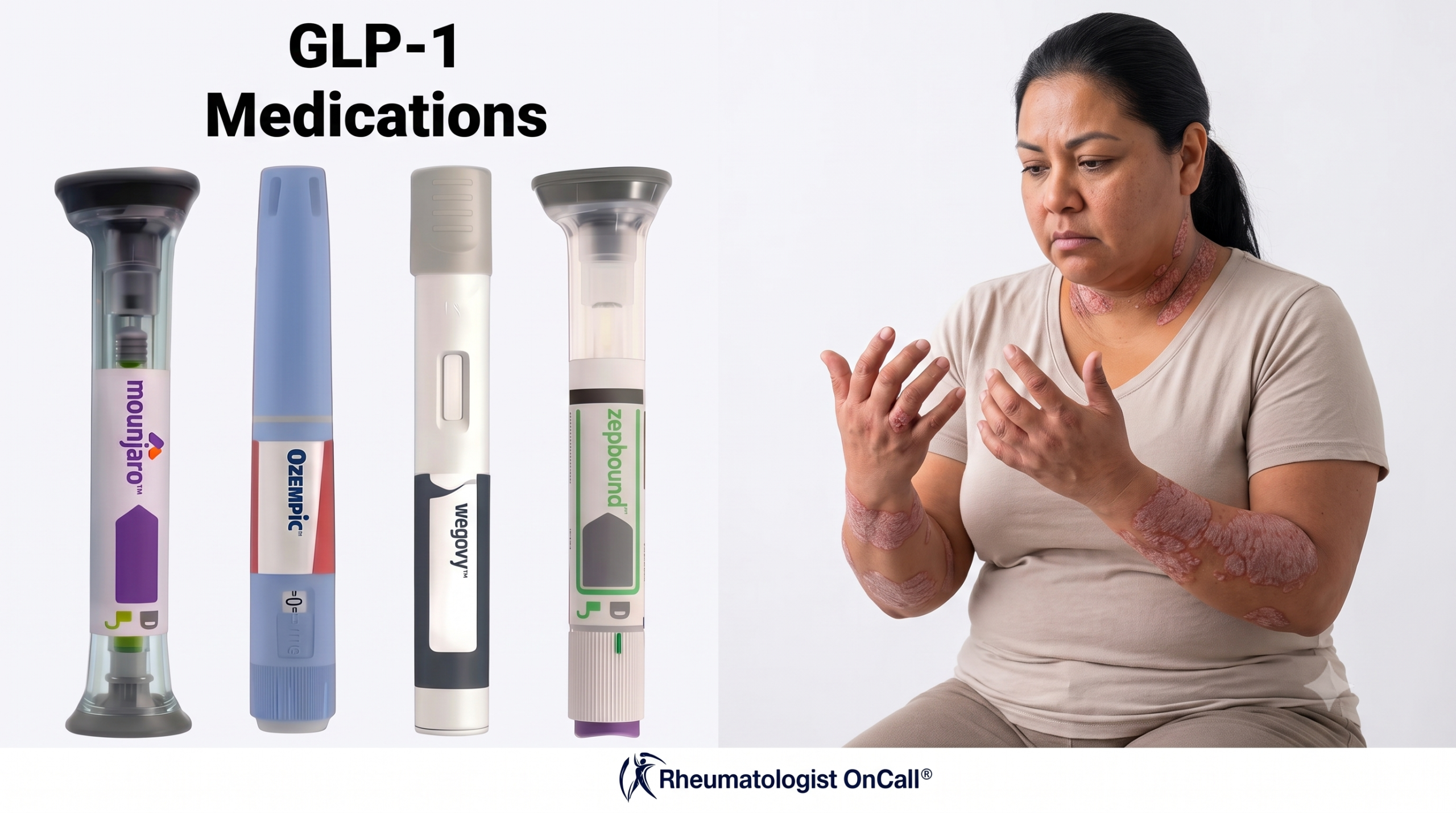
GLP-1 medications (semaglutide, tirzepatide, liraglutide, and others, sold under brand names like Ozempic, Wegovy, Mounjaro, and Zepbound) were built for type 2 diabetes and weight loss. But rheumatologists and dermatologists have started noticing something extra: these drugs quiet down inflammation, including the specific inflammation that drives psoriatic disease.
The published research is catching up to what many of us see in clinic:
- In a randomized trial, 12 weeks of semaglutide dropped patients’ psoriasis severity scores (PASI) from 21 to 10 — roughly cutting the disease in half.
- In a prospective study, liraglutide improved PASI scores from 15.7 all the way down to 2.2.
- A case of severe, biologic-resistant plaque psoriasis cleared dramatically after semaglutide was added — psoriasis that had previously failed adalimumab.
- At ACR Convergence 2025, a cohort of 48 people with psoriatic arthritis who started a GLP-1 showed a significant drop in CRP (a key inflammation marker) and lower pain scores, with joint disease activity trending down as well.
None of this means a GLP-1 is a stand-alone treatment for psoriatic disease. It means it can be a powerful partner to the treatment you’re already on.
What happened when I added a GLP-1 to Daniel’s biologic
Daniel’s biologic wasn’t a bad drug. His body was working against it. The extra inflammation his metabolism was producing kept overwhelming what the Simponi could block. When I added Ozempic, I wasn’t swapping out his biologic — I was clearing the path so it could finally do its job. Within months, his CRP came down, his flares became rare, and his skin cleared. The biologic didn’t change. The environment it was working in did.
Why do biologics sometimes stop working — and how can a GLP-1 help?
A biologic can “fail” not because it’s the wrong drug, but because the body is manufacturing the very molecules the biologic is trying to block. In many of my patients, the source of those molecules is their own fat tissue.
For years, when a patient failed a biologic, I blamed the drug. Then it clicked for me: their own fat tissue was producing the exact inflammatory signals — IL-6, TNF, and IL-17 — that the biologic was designed to shut down. No wonder the medication couldn’t keep up. It was trying to bail out a boat while something kept pouring water back in.
Once I started treating that underlying inflammation, most patients felt noticeably better — more energy, less pain, less stiffness. That shift changed how I practice. I stopped treating the joint in isolation and started treating the whole inflamed person.
This lines up with what the research shows: patients with obesity tend to have more severe psoriasis and lower response rates to biologics, partly because excess fat tissue increases the inflammatory burden the drug has to overcome.
Is there a link between obesity, psoriasis, and psoriatic arthritis?
Yes. Obesity and psoriatic disease are tightly linked — and the connection runs through inflammation, not just body size. Here’s what I wish every patient understood: your fat tissue isn’t sitting there quietly. It’s an active factory.
Fat tissue — especially the fat around your organs — behaves like an endocrine and immune organ. It pumps out the same pro-inflammatory cytokines that drive psoriasis and psoriatic arthritis: TNF-alpha, IL-6, and IL-17. Research shows this creates a self-perpetuating loop, where fat inflammation feeds skin and joint inflammation, and vice versa. It also throws off the balance of helpful signals like adiponectin (anti-inflammatory) and unhelpful ones like resistin.
That’s why weight is never just about weight in psoriatic disease. More fat tissue can mean more of the exact molecules making your skin and joints worse.
How much weight loss actually makes a difference?
You don’t need to reach an “ideal” weight to see a benefit — even modest, steady weight loss can turn the inflammation factory down. In a study of people with psoriatic arthritis, significant weight loss led to meaningful improvements in tender and swollen joint counts, CRP, enthesitis, and physical function — and the more weight patients lost, the more their disease improved, in a dose-response pattern.
And here’s the bonus that makes GLP-1 medications different from dieting alone: the drug carries its own anti-inflammatory punch, layered on top of whatever benefit comes from weight loss. You get two effects working together.
Do GLP-1 medications reduce inflammation even without weight loss?
This is the question I most want researchers to chase — because in my clinic, I’ve seen the answer trend toward yes. Some of the improvement in psoriatic disease appears to happen at least partly independent of weight loss, pointing to a direct anti-inflammatory effect of the drug itself.
There’s growing signal in the literature: an open-label trial of weekly semaglutide in people with psoriasis and diabetes found significant reductions in IL-6 and CRP alongside skin improvement, and reviewers have repeatedly noted that some patients’ skin gets better even when the scale barely moves.
Let me tell you about another patient, this one from Arizona. She isn’t obese — she isn’t even overweight. But her rheumatoid arthritis was out of control despite a full-dose DMARD and a full-dose biologic. She was having multiple flares a month and was exhausted. She looked at me and asked, “What else can I do?” I gave her a microdose of a GLP-1 — not for weight loss, purely for the inflammation. Four months later, her flares had dropped to about one a month, her energy was back, and we were tapering her medications down instead of piling more on.
That’s the case I want a journal to chase: does a low-dose GLP-1 calm disease activity even when there’s no weight to lose? I’ve watched it happen. Now I want it proven.
(This is a real, anonymized case. It is not a recommendation, and microdosing for inflammation is not yet an established, guideline-backed use. Results vary.)
If you want the deeper dive on low-dose GLP-1 protocols, I go into detail in my companion article on microdosing Ozempic for psoriatic arthritis.
Which GLP-1 medications are we talking about?
Not all GLP-1 medications are identical. Here’s how the main players compare in plain language.
| Medication (generic) | Common brand names | How it works | Where the evidence sits for psoriatic disease |
|---|---|---|---|
| Semaglutide | Ozempic, Wegovy, Rybelsus | Single GLP-1 receptor agonist | Most human data so far — PASI improvement, lower IL-6 and CRP |
| Tirzepatide | Mounjaro, Zepbound | Dual GIP + GLP-1 agonist | Strong metabolic effect; a randomized trial showed it added disease control when combined with a biologic in PsA |
| Liraglutide | Victoza, Saxenda | Daily GLP-1 receptor agonist | Older data showing PASI improvement and immune changes in the skin |
| Retatrutide | (investigational) | Triple hormone agonist | Not yet approved; being studied for metabolic disease |
The brand name that matters most is the one that fits your medical history, insurance, and goals — a decision that belongs with your physician.
Who might benefit from a GLP-1 for psoriatic disease?
A GLP-1 is worth discussing with your rheumatologist if you recognize yourself in this list:
- You have psoriasis or psoriatic arthritis plus overweight or obesity
- Your biologic used to work and now seems to be losing its grip
- Your inflammation markers (like CRP) stay stubbornly high
- You have metabolic syndrome, prediabetes, or type 2 diabetes alongside your psoriatic disease
- Your disease and your weight both feel stuck, and nothing has moved the needle
This is not a reason to abandon your current treatment. It’s a reason to have a fuller conversation about the whole picture.
Who should NOT take a GLP-1?
GLP-1 medications are real drugs with real contraindications — powerful, not magic. They aren’t right for everyone. You should generally avoid them if you have a personal or family history of medullary thyroid cancer or MEN2 syndrome, or a history of pancreatitis. They can also cause nausea, and they interact with other conditions and medications. That’s exactly why this belongs in a doctor’s office, not a comment section.
The bottom line from a rheumatologist
GLP-1 medications are one of the most interesting tools to land in rheumatology in years. For the right patient, even a microdose can be genuinely life-changing — I’ve watched skin clear, flares fade, and people get their lives back.
But I’ll be honest about the caveats, because you deserve them: the strongest evidence so far is in people who also carry extra weight, a lot of the psoriasis data comes from small studies and case reports, and the “works even without weight loss” idea is still emerging rather than settled. These drugs are a partner to good rheumatology care, not a replacement for it.
What frustrates me is how few rheumatologists are even having this conversation with their patients. It’s a conversation that belongs in a rheumatologist’s office — not on TikTok.
If you’re wondering whether a GLP-1 medication could fit into your psoriatic disease treatment plan, that’s a conversation worth having with a rheumatologist who looks at the whole inflamed person. That’s exactly the kind of care we focus on at Rheumatologist OnCall.
References
- Eder L, Scher U, Chen K, et al. Glucagon-like peptide-1 receptor agonists therapy is associated with improvement in psoriatic arthritis-related and metabolic outcomes: a retrospective analysis of two cohorts. Arthritis Rheumatol. 2025; 77 (suppl 9). ACR Convergence 2025. Read the abstract
- Tsibadze N. GLP-1 receptor agonists reduce cardiovascular events and mortality in psoriatic arthritis. Abstract 0849, ACR Convergence 2025. Healio coverage
- Costanzo G, et al. The therapeutic potential of glucagon-like peptide-1 receptor agonists in psoriasis and hidradenitis suppurativa: a systematic review. J Clin Aesthet Dermatol. 2026. Read the review
- Two birds one stone: semaglutide is highly effective against severe psoriasis in a type 2 diabetic patient. PubMed, 2021. Read the case report
- Exploring the link between psoriasis and adipose tissue: one amplifies the other. Int J Mol Sci. 2024. Read the study
- GLP-1 receptor agonists: emerging therapeutic potential in psoriasis management — current evidence and future outlook. PubMed, 2025. Read the review
- Merola JF, Mease P, Kivitz A, et al. Ixekizumab with tirzepatide achieved greater disease control than ixekizumab alone in adults with psoriatic arthritis and overweight or obesity: results from a randomized clinical trial. ACR, 2025. Read the abstract listing
This article is for educational purposes and does not constitute medical advice. Diana Girnita, MD, PhD, FACR — double board-certified rheumatologist, founder of Rheumatologist OnCall, telehealth practise serving multiple US states, PhD in immunology.
Author
Frequent asked questions
Can Ozempic clear psoriasis?
In some patients, yes — Ozempic (semaglutide) has been linked to significant improvement in psoriasis severity, and in a few striking cases, near-complete clearing. But responses vary widely, and it works best as part of a broader plan rather than on its own.
Does semaglutide help plaque psoriasis?
Studies and case reports show semaglutide can reduce PASI scores (a measure of psoriasis severity) and lower inflammation markers like IL-6 and CRP, including in people whose psoriasis had resisted other treatments. It is not FDA-approved specifically for psoriasis.
How long before psoriasis improves on a GLP-1?
In published cases and my own practice, skin improvement often shows up over roughly three to six months, not overnight. Consistency matters more than speed.
Can GLP-1 medications treat psoriatic arthritis?
They can help reduce inflammation, pain, and flare frequency in psoriatic arthritis, and research presented at ACR Convergence 2025 showed lower CRP and improving disease activity in PsA patients who started a GLP-1. They are not a substitute for DMARDs or biologics.
Will a GLP-1 replace my biologic?
No. In my experience, a GLP-1 doesn’t replace a biologic — it helps the biologic work better by lowering the background inflammation your body is producing. Think partner, not replacement.
Can a GLP-1 help if my biologic stopped working?
Sometimes, yes. When a biologic seems to be “failing,” part of the problem can be inflammation coming from fat tissue that the biologic can’t keep up with. Addressing that with a GLP-1 has, in some of my patients, brought a struggling biologic back to life.
Do you have to lose weight for a GLP-1 to help psoriasis?
Not entirely. Weight loss clearly helps psoriatic disease, but some of the anti-inflammatory benefit appears to come from the drug directly, and improvement has been reported even without major weight change.
Can a GLP-1 help if I’m not overweight?
This is an open research question. I’ve seen a low-dose GLP-1 calm disease activity in a lean patient with rheumatoid arthritis, but this is not yet an established, guideline-backed use — it needs formal study.
What is microdosing a GLP-1?
Microdosing means using a smaller-than-standard dose, aiming for the anti-inflammatory effect rather than weight loss. I cover this in depth in my article on microdosing Ozempic for psoriatic arthritis.
Are GLP-1 medications safe for autoimmune disease?
For many patients they are well tolerated, but they have real contraindications and side effects, and they aren’t right for everyone. Safety depends on your individual history, which is why this decision belongs with your physician.
Who should not take a GLP-1?
People with a personal or family history of medullary thyroid cancer or MEN2 syndrome, or a history of pancreatitis, generally should not take these medications. Your doctor will review your full history before starting one.
How do I ask my rheumatologist about GLP-1 medications?
Bring it up plainly: mention your psoriasis or psoriatic arthritis, any weight or metabolic concerns, and ask whether a GLP-1 might help lower your inflammation. If your current rheumatologist isn’t exploring this, it’s a fair reason to seek a second opinion.