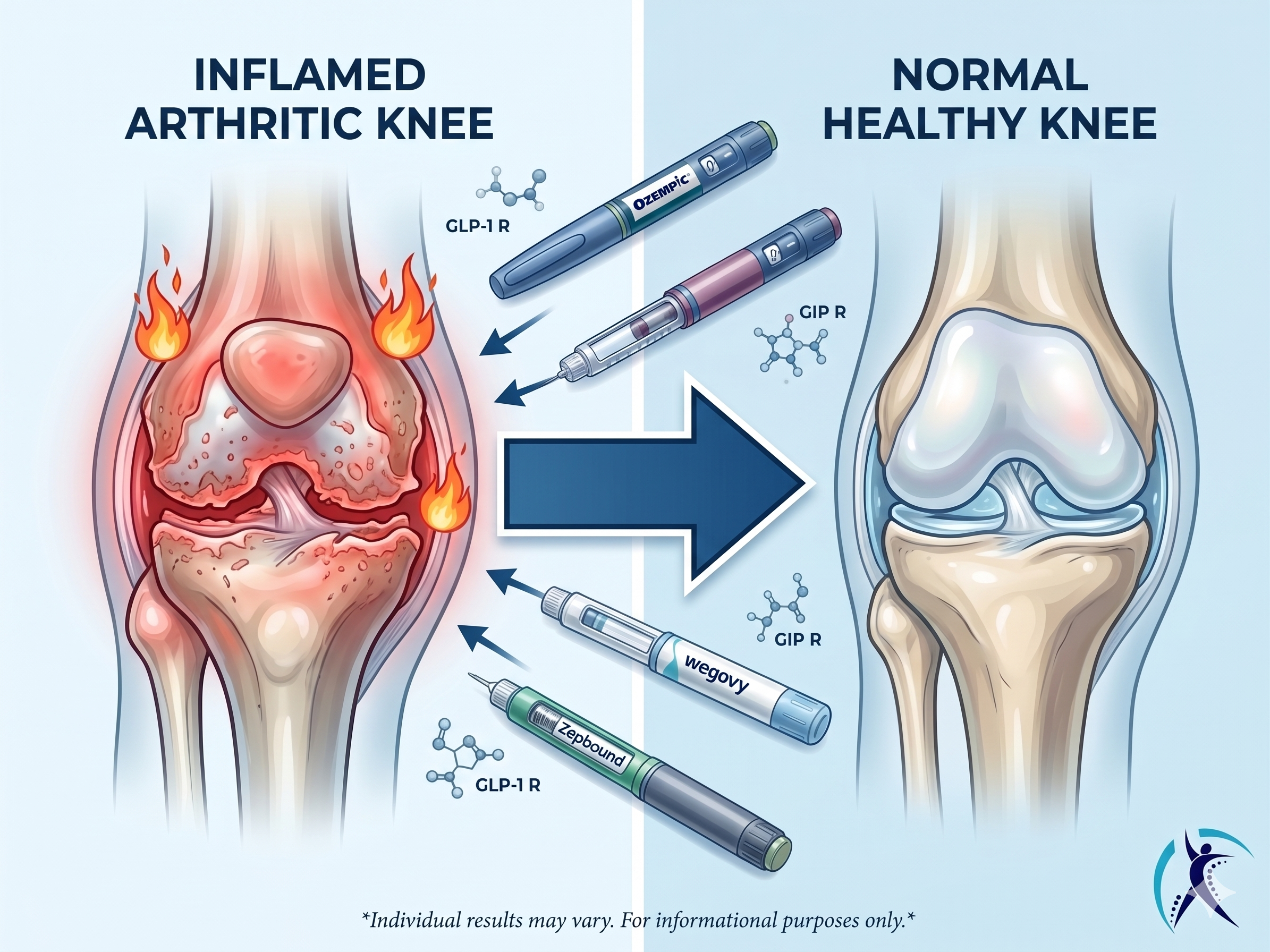
If you live with knee osteoarthritis, you have probably wondered whether the weight-loss medication everyone is talking about could actually help your joints — not just the number on the scale. It is one of the most common questions I hear in my clinic, and over the past two years the science has moved fast enough that my answer has genuinely changed. The short version: for the right patient, GLP-1 medications can reduce knee pain, improve how well you walk, and — when osteoarthritis is caught before it becomes bone-on-bone — may help delay or even postpone knee replacement by years.
Let me explain how the evidence is strongest and where the limits are.
New to this topic? Start with my overview, Does Ozempic Help Arthritis?, then come back here for the deep dive on knees.
What is knee osteoarthritis, really?
Osteoarthritis (OA) is the most common form of arthritis, and the knee is the joint it affects most. For decades, it was written off as simple “wear and tear” — the idea that cartilage just grinds down with age and use, like a tire losing its tread.
We now know that picture is incomplete.
Cartilage is the smooth, slippery tissue that caps the ends of your bones and lets the joint glide. In osteoarthritis, the cartilage thins and breaks down, the underlying bone remodels and forms spurs (osteophytes), and the joint lining (synovium) becomes inflamed. That inflammation is key — osteoarthritis is not purely mechanical. Low-grade, body-wide inflammation actively drives the disease forward, which is exactly why a medication that calms inflammation can matter for a “mechanical” problem.
The result is pain, stiffness, swelling, and — for many of my patients — a slow loss of the ability to do ordinary things: climbing stairs, getting out of a chair, walking the dog, sleeping through the night.
Why would you want to avoid (or postpone) a knee replacement?
Total knee replacement is one of the most successful operations in modern medicine, and for severe, end-stage osteoarthritis it can be life-changing.
I am not against it.
But it is worth understanding why delaying it — when it is safe to do so — is often the smarter play:
- Implants do not last forever. A knee replacement has a finite lifespan, and the younger you are when you get one, the more likely you are to outlive it and need a second operation. Revision surgery is more complex and has worse outcomes than the first replacement. Postponing the first replacement can mean avoiding a second one entirely.
- It is major surgery. It carries real risks — blood clots, infection, anesthesia complications — and recovery takes months of rehab.
- Outcomes are worse at higher weights. Surgery on a patient with significant obesity carries higher complication rates, and many surgeons ask patients to lose weight first.
- Not everyone is satisfied. A meaningful minority of patients still have pain or stiffness after surgery.
So the goal for many of my patients is not “surgery or nothing.”
It is: can we control pain, restore function, and protect the joint long enough that surgery is delayed for years — or, in earlier disease, avoided altogether?
Why does losing weight help knee osteoarthritis so much?
This is where weight loss becomes genuinely therapeutic, through two separate channels.
The mechanical channel. Your knees carry your body. Every pound of body weight translates into roughly four pounds of force across the knee with each step. Lose 10 pounds, and you take about 40 pounds of load off the joint with every stride — multiplied across the thousands of steps you take each day. That is enormous relief for a joint that hurts.
The inflammatory channel. Fat tissue is not inert padding. It actively pumps out inflammatory molecules — IL-6, TNF-alpha, IL-1 — the same signals that inflame the joint lining and accelerate cartilage breakdown. Losing fat turns down that inflammatory output. So weight loss helps the knee twice: less load and less inflammatory fuel.
This is the foundation on which GLP-1 medications build — and, as you will see, they appear to do even more than weight loss alone.
A patient who could barely walk
Let me tell you about a patient — I will call her Linda.
Linda came to me at 58, carrying about 240 pounds on a 5-foot-4 frame. Her knee X-rays showed advanced osteoarthritis, and an orthopedic surgeon had already raised the subject of a double knee replacement. By the time she reached my office, the walk from the parking lot to the clinic door had left her in tears. She had stopped going to her grandchildren’s events because she could not manage the bleachers. She told me she felt like she was “disappearing” from her own life.
Surgery was on the table — but Linda was terrified of it, and at her weight, her surgeon wanted her lighter before operating anyway. So we built a different plan. Alongside physical therapy, I started her on a GLP-1 medication (tirzepatide), titrated slowly.
Over the next year she lost about 45 pounds. The change in her knees was not subtle. Her morning stiffness shrank, the swelling settled, and — the moment I remember most — she walked into a follow-up visit without her cane and told me she had gone to a full afternoon at the zoo with her grandkids.
She is not “cured”; her arthritis is still there on the X-ray. But her pain is manageable, she is moving again, and her surgeon has agreed to hold off on replacement and reassess in a year or two. For Linda, that postponement is everything.
Linda’s story is not a guarantee — results vary, and her osteoarthritis was advanced. But it captures what I increasingly see in practice, and it lines up with what the trials are now showing.
Ozempic, Wegovy, Mounjaro, Zepbound — and now retatrutide: what is the difference?
Patients mix these names up constantly, so here is the clean version. There are now three molecules worth knowing for knees:
- Semaglutide — a single-receptor (GLP-1) drug. Sold as Ozempic (lower dose, approved for type 2 diabetes) and Wegovy (higher dose, approved for obesity). This is the molecule with the strongest published evidence for knee osteoarthritis so far.
- Tirzepatide — a dual-receptor drug (GLP-1 and GIP). Sold as Mounjaro (diabetes) and Zepbound (weight management). It tends to produce more weight loss on average than semaglutide. It does not yet have a dedicated knee-osteoarthritis trial, but given the mechanical and anti-inflammatory benefits of weight loss, it is reasonable to expect a class effect.
- Retatrutide — an investigational triple-receptor drug (GLP-1, GIP, and glucagon) from Eli Lilly. It is not yet FDA-approved, but it just posted the most dramatic knee-osteoarthritis trial results to date (more on that below).
The pattern is roughly that each added receptor tends to increase the weight-loss power: one receptor (semaglutide), two (tirzepatide), three (retatrutide). For the knee, more weight loss generally means more mechanical relief — but, importantly, the joint benefit is not only about weight.
What does the STEP-9 trial show about semaglutide and knee osteoarthritis?
The landmark study here is STEP-9, published in the New England Journal of Medicine in late 2024. It is the trial that changed how I think about this question.
STEP-9 enrolled 407 adults with obesity and moderate knee osteoarthritis, randomly assigning them to semaglutide 2.4 mg or placebo, alongside diet and activity counseling, for 68 weeks. The results:
- The semaglutide group lost about 13.7% of body weight, versus roughly 3.2% on placebo.
- Their knee pain dropped substantially more than placebo on the WOMAC pain scale — a reduction far larger than weight loss alone would predict.
- Physical function improved significantly — patients moved better, not just hurt less.
That last point matters.
The pain relief in STEP-9 was bigger than you would expect from the pounds lost, which is a strong hint that semaglutide is doing something to the joint beyond simply unloading it. The newest research suggests exactly what that “something” might be.
The genuinely new part: GLP-1s may protect cartilage itself
Here is what was not in the conversation even a year ago. In early 2026, a study published in Cell Metabolism reported that semaglutide had a direct, weight-loss-independent protective effect on cartilage. Working in obese mouse models of osteoarthritis — and supported by a small randomized human pilot trial — the researchers showed that semaglutide reduced cartilage degeneration, reduced bone spur formation, reduced joint-lining inflammation, and lowered pain sensitivity. Crucially, these benefits persisted even when the animals’ weight was held constant.
The proposed mechanism is fascinating: semaglutide appears to reprogram the metabolism of chondrocytes (the cells that build and maintain cartilage) through a pathway the authors call the GLP-1R–AMPK–PFKFB3 axis, shifting those cells toward a more efficient, repair-friendly energy state. In plain terms, the drug may help cartilage cells survive and function better under the inflammatory stress of osteoarthritis.
I want to be honest about where this stands: this is early science — mostly preclinical, with only a small human pilot so far.
It does not prove that Ozempic rebuilds human knees.
But it is the first serious mechanistic evidence that GLP-1 medications might one day act as disease-modifying osteoarthritis drugs, not just symptom relievers. That would be a major shift, because we currently have no approved drug that slows the progression of osteoarthritis.
And the most powerful trial yet: retatrutide (TRIUMPH-4)
In December 2025, Eli Lilly announced topline results from TRIUMPH-4, the first phase 3 trial of retatrutide (the triple agonist) specifically in adults with obesity and knee osteoarthritis. Across 445 participants over 68 weeks:
- Weight loss reached up to an average of 28.7% (about 71 pounds) at the highest dose.
- WOMAC knee-pain scores fell by up to about 76%, compared with roughly 40% on placebo.
- Physical function improved markedly, and in a post hoc analysis, more than 1 in 8 treated patients were completely free of knee pain at the end of the trial — versus about 1 in 25 on placebo.
These are striking numbers. Retatrutide is still investigational and not available outside trials, and full peer-reviewed results are pending. But Lilly’s own framing is telling: they describe these as patients who often “may eventually require total joint replacement” — and that is precisely the population we are trying to keep out of the operating room.
Can a GLP-1 actually help you avoid or postpone knee replacement?
Here is how I put all of this together for a real patient.
If your osteoarthritis is early-to-moderate — there is still cartilage left, and you are not yet bone-on-bone — substantial weight loss plus the joint-level effects of a GLP-1 can meaningfully reduce pain, improve function, and potentially slow the disease’s march toward surgery. For some of these patients, replacement may be avoided for the foreseeable future.
If your osteoarthritis is advanced — as Linda’s was — surgery may still be in your future, but getting lighter and stronger first can let you postpone it by years, reduce surgical risk when the time comes, and sometimes make the operation safer and more successful.
What a GLP-1 will not do is regrow a severely worn, bone-on-bone joint or replace the value of surgery in end-stage disease. Anyone promising that is overselling it. And these drugs are not for everyone — they are generally avoided in people with a personal or family history of medullary thyroid cancer or MEN2, a history of pancreatitis, severe gastroparesis, or in pregnancy. Rapid weight loss also carries some signals worth monitoring, including possible effects on bone density and a temporary risk of gout flares early on. This is why the decision belongs with a clinician who knows your whole picture — not a quick-visit weight-loss clinic.
How our clinic can help
At Rheumatologist OnCall, this is exactly the kind of problem we are built to solve. As a rheumatology practice, we look at your knees through both lenses — the mechanical joint damage and the metabolic inflammation driving it — and we coordinate with your orthopedic surgeon rather than working around them.
If you are facing a knee-replacement conversation, struggling to lose weight on your own, or simply want to know whether a GLP-1 medication (including lower-dose approaches) fits your situation, we can help you weigh the options, navigate insurance hurdles, and build a plan that protects your joints for the long run. You can learn more or book a consultation at rheumatologistoncall.com.
References
- Bliddal H, et al. Once-weekly semaglutide in persons with obesity and knee osteoarthritis (STEP 9). New England Journal of Medicine. 2024;391:1573–1583.
- Qin Y, et al. Semaglutide ameliorates osteoarthritis progression through a weight loss-independent metabolic restoration mechanism. Cell Metabolism. 2026.
- Eli Lilly and Company. Retatrutide delivered weight loss and relief from osteoarthritis pain in the phase 3 TRIUMPH-4 trial (topline results). December 2025.
Medical Disclaimer
This article is for educational purposes and does not constitute medical advice.
About the Author
Diana Girnita, MD, PhD, FACR is a double board-certified rheumatologist and the founder of Rheumatologist OnCall, a virtual arthritis and autoimmune diseases practice serving many US states. She holds a PhD in immunology.
Author
Frequent asked questions
Does Ozempic help knee osteoarthritis?
Yes — in the STEP-9 trial, semaglutide (the molecule in Ozempic and Wegovy) reduced knee pain and improved physical function in people with obesity and knee osteoarthritis, with pain relief greater than weight loss alone would explain. It is not yet FDA-approved specifically for osteoarthritis.
Does Ozempic work on knees only because of weight loss?
Partly, but not entirely. Beyond unloading the joint, 2026 research in Cell Metabolism suggests semaglutide may directly protect cartilage through a weight-independent metabolic pathway. This is early evidence, mostly preclinical so far.
Can losing weight delay a knee replacement?
Often, yes. Weight loss reduces both the mechanical load on the knee (roughly four pounds of force per pound of body weight) and inflammation, which can ease pain, improve function, and postpone or, in earlier disease, sometimes avoid surgery.
Which GLP-1 is best for knee osteoarthritis?
Semaglutide (Ozempic) has the strongest published human evidence (STEP-9). Retatrutide, a triple agonist, showed the largest pain and weight effects in the 2025 TRIUMPH-4 trial but is still investigational. Tirzepatide (Mounjaro, Zepbound) lacks a dedicated knee trial but offers strong weight loss.
Will a GLP-1 regrow my cartilage?
There is no proof of that in humans yet. Early animal and pilot data suggest a cartilage-protective effect, but you should not expect a worn, bone-on-bone joint to be rebuilt by these medications.
Is Ozempic approved to treat osteoarthritis?
No. GLP-1 medications are approved for type 2 diabetes and weight management. Their use for osteoarthritis is supported by emerging research but is not an FDA-approved indication, so it should be guided by a physician.